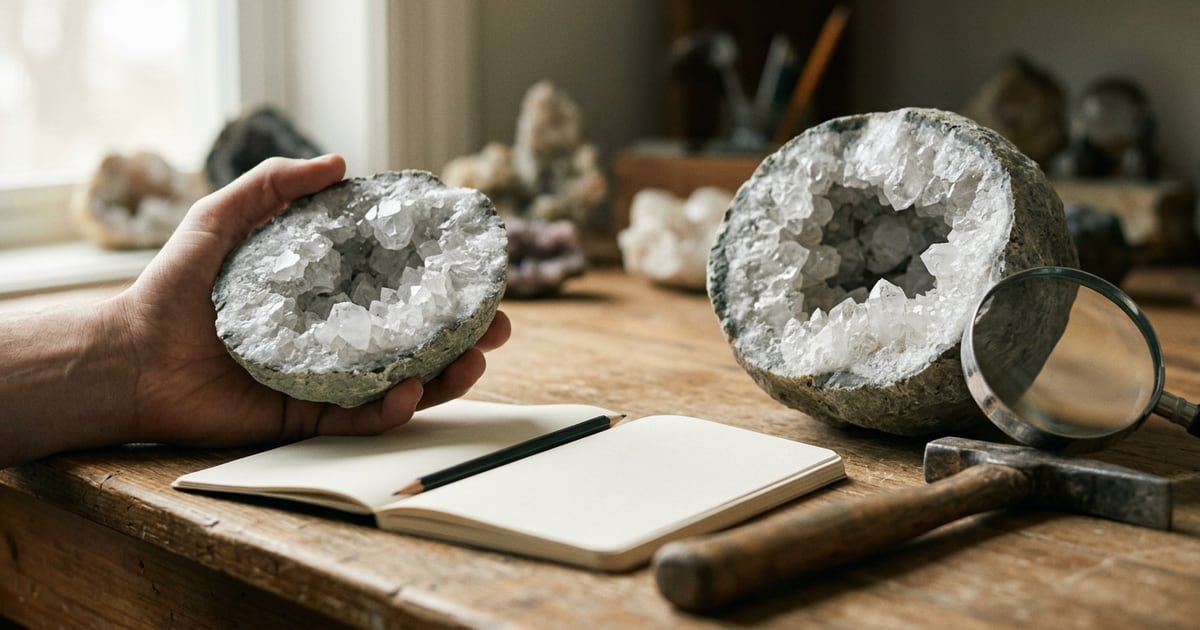


You picked up a round, lumpy rock on a hike or in a creek bed, and now you're wondering whether there are crystals hiding inside. Here's the short answer: most geodes are roughly round, have a bumpy crust, feel light for their size and sound a little hollow when tapped. This guide walks you through seven signs you can check without breaking the rock, the stones most often mistaken for geodes, and the one test that settles the question for good.
What a geode looks like
A geode is a hard, roughly round rock with a cavity inside that's lined with crystals. The Indiana Geological and Water Survey describes geodes as "hard, subspherical nodules of quartz rock" that range from less than 1 inch to more than 2 feet in diameter.
From the outside, they are not much to look at. The Iowa Geological Survey describes "drab, rounded exteriors with a hard outer layer and partially hollow interiors lined with inwardly projecting mineral crystals." That plain shell is why geodes are easy to miss.
Inside, quartz is the most common crystal. Calcite also shows up often, and the Indiana survey notes that at least 20 different minerals have been identified in Indiana geodes. Some geodes are only partly hollow. Others are completely filled, which matters when you run the tests below.
7 features to check
Use these signs together. One sign alone proves little. Four or five pointing the same way is a good reason to open the rock.
1. Shape: round or egg-shaped
Geodes form as rounded nodules, so most are close to a ball, an egg or a slightly squashed sphere. Sharp corners, flat broken faces and long, thin shapes all count against a geode.
Example: a fist-sized rock that rolls when you set it on a table is a better candidate than a wedge-shaped one that sits flat on a broken face.
2. Texture: a bumpy, cauliflower-like crust
Run your fingers over the surface. Many geodes have a knobbly, lumpy skin that looks a little like the top of a cauliflower. Smooth, water-polished pebbles and grainy, crumbly rocks are less likely to be geodes.
Why it works: the outer wall of many geodes is made of chalcedony, a fine-grained form of quartz, which often forms in rounded, bumpy layers.
3. Weight: lighter than it looks
Hold the rock in one hand and a similar-sized ordinary stone in the other. A geode with a big hollow centre can feel noticeably lighter, because part of it is empty space.
Keep this test loose. A geode that is mostly filled with crystals can feel as heavy as a solid rock, so a heavy stone isn't ruled out.
4. Sound: a dull or hollow tap
Tap the rock lightly with a small hammer or another hard stone and listen. A hollow geode often gives a duller, slightly hollow sound. A solid rock tends to give a sharper, higher "click."
Example: tap three similar-sized creek rocks in a row, then tap your candidate. Comparing sounds side by side is far easier than judging one rock alone.
5. Hardness: quartz scratches glass
Most geode shells are quartz, which sits at 7 on the Mohs hardness scale. Window glass and a steel knife blade are both about 5.5, according to the University of Notre Dame's mineral lab guide. So a quartz shell should scratch glass, and a steel knife should not scratch it.
How to do it: press a clean edge of the rock firmly across an old glass bottle or tile, then wipe the mark. A real scratch stays. A mark that rubs off is just powder from the rock. Wear gloves and work slowly.
6. Location: the right kind of ground
Geodes come from particular rock layers, so where you found the rock is a strong clue. In Iowa, geodes come from the Warsaw Shale and nearby layers around Keokuk, and Iowa named the geode its official state rock in 1967. In south-central Indiana, the Indiana survey points to the Harrodsburg Limestone and Ramp Creek Formation, and notes that geodes concentrate in streams because they resist weathering.
If you found a round, bumpy rock in a creek in a known geode area, that's a much better bet than the same rock in a garden bed far from any geode-bearing rock. Before you collect, check local rules: Iowa's Geode State Park, for example, does not allow visitors to remove geodes.
7. Cracks and openings: a peek inside
Turn the rock over slowly in good light. Sometimes a geode has a small crack, a broken corner or a hole where you can see a glint of crystal or a dark gap. A loupe or the zoom on your phone camera helps here.
This is the closest you can get to seeing inside without opening it. If you spot sparkly crystal faces through a gap, you very likely have a geode.
Putting the signs together
A simple way to decide is to score your rock. Give it one point for each sign it passes: round shape, bumpy crust, light weight, hollow sound, scratches glass, found in a known geode area, crystal visible through a crack.
Worked example: a tennis-ball-sized rock from a creek in southeastern Iowa is round (1), knobbly (2), feels light next to a similar stone (3), and scratches an old bottle (4). It sounds solid, and there's no crack to look through. Four out of seven is a promising score, so it's worth opening carefully or taking to a rock shop. A rock that scores one or two is probably not a geode, however pretty it looks.
Look-alikes
Several common rocks are easy to confuse with geodes.
- Thundereggs. These round nodules form in volcanic ash and are often solid, filled with agate, jasper or opal. They're Oregon's official state rock. From the outside they can look just like a geode, but most will be heavy and won't sound hollow.
- Solid nodules. Some geode-like nodules filled in completely with chalcedony or crystal. They pass the shape and texture tests but fail the weight and sound tests.
- Concretions. These are round lumps of hardened sediment, often sandstone or iron-rich mud. They can be very round, but they usually have a grainy, sandy or rusty surface rather than a knobbly quartz crust.
- Rounded river cobbles. Water tumbling wears ordinary rocks into smooth, round pebbles. The giveaway is the surface: smooth and polished rather than knobbly.
- Man-made or dyed "geodes." Some shop pieces are dyed agate slices or glued-together crystal halves. If a geode for sale has unnatural bright pink or blue colour, ask the seller whether it's dyed.
When to ask an expert
Home tests can narrow things down, but they can't promise there are crystals inside. Ask for help when:
- You think the rock may be valuable and don't want to crack it badly. A local rock shop or lapidary club can cut it cleanly with a saw.
- The rock is very heavy, metallic or magnetic. That's a different question entirely, and a geology department or natural history museum is the right place to ask.
- You found it on protected land. Parks and reserves often ban collecting, so check before you take anything home.
- The tests disagree. If the shape says "geode" but the weight and sound say "solid," a club member who has handled hundreds of local stones will often know at a glance.
State geological surveys, such as the Indiana and Iowa surveys linked above, also publish free guides to the rocks found in their area.
How AI Gem can help
AI Gem lets you take a photo of a rock or upload one from your gallery and get a suggested identification, with details such as hardness, colour, luster and formation type. That's useful when you're standing at a creek bed and want a second opinion before carrying a heavy stone home. You can save each find to a personal collection and look back at past scans. Treat the result as a starting point rather than a final answer: an app can't see inside an unopened rock, so the tests above still matter. For more guides like this one, browse the AI Gem blog.
Frequently asked questions
Can you tell if a rock is a geode without breaking it?
You can make a strong guess. Look for a round shape, a bumpy crust, a rock that feels light for its size and a dull or hollow sound when tapped. None of these signs is certain on its own, so the only sure answer is to open the rock or have it cut with a rock saw.
What does an unopened geode look like?
Most unopened geodes look plain: a grey, brown or tan ball with a lumpy, knobbly surface a little like a cauliflower. They are rarely sharp or angular. The Iowa Geological Survey describes them as having drab, rounded exteriors with a hard outer layer, which is why many people walk past them.
Are all geodes hollow?
No. Some geodes are partly or completely filled with crystals or with banded chalcedony. A filled one is often called a nodule. Thundereggs, which form in volcanic ash, are usually solid too. A filled stone can still be beautiful when cut and polished, but it will feel heavy and will not sound hollow.
Where are geodes most often found?
In the United States, well-known geode areas include southeastern Iowa around Keokuk, south-central Indiana, and parts of Missouri, Illinois, Kentucky and Utah. They often collect in stream beds, because their hard quartz shells resist weathering better than the rock around them.
What is the safest way to open a geode?
Wear safety glasses, put the geode in an old sock or wrap it in a cloth, and tap it gently along a line with a small rock hammer until it splits. Never hit it near your hand or other people. Collectors with a valuable stone often pay a rock shop to cut it with a saw instead.
Conclusion
To tell if a rock is a geode, check seven things: a round shape, a bumpy crust, a light weight, a hollow sound, a quartz-hard shell, a known geode area, and any crack that shows crystal inside. The more signs that line up, the better your odds. Watch for look-alikes like thundereggs and concretions, follow local collecting rules, and remember that the only certain test is to open the rock safely, or have a rock shop cut it for you. You can find more rock and nature guides on the Alic Systems blog.