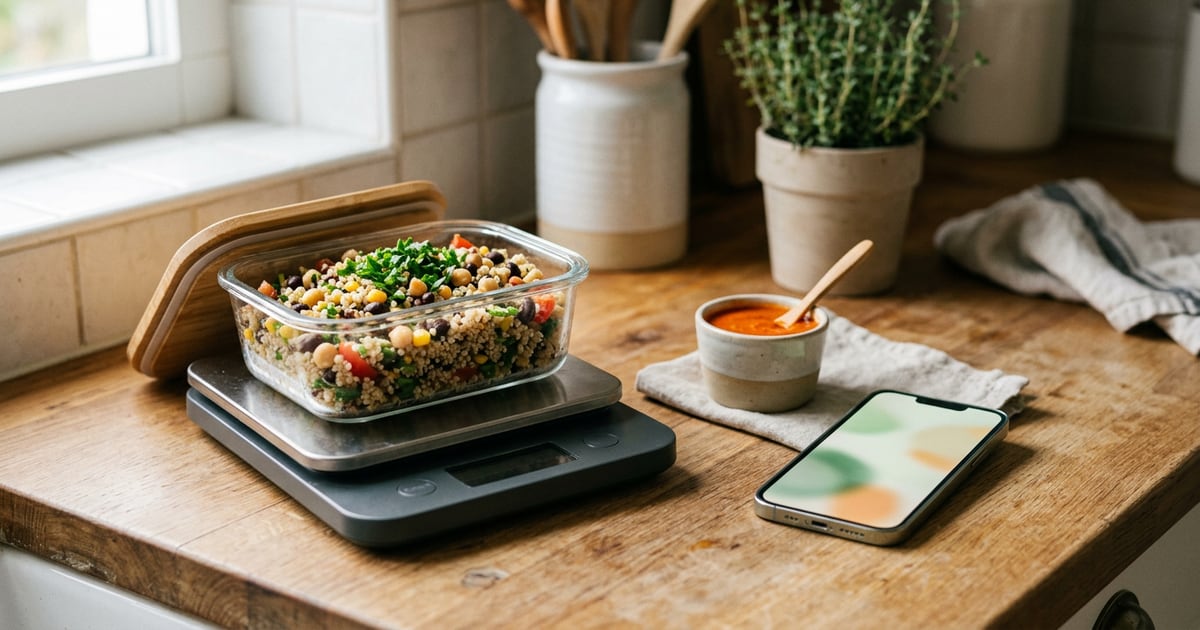


A common mistake when calculating calories in homemade food is dividing by the number of portions you planned to sell before checking how many portions the batch actually produced. Start with the ingredients that go into the finished food, estimate the energy for the batch and divide by the measured yield. For a small meal-prep business, keep that calculation with the recipe and the packing instructions. The example below shows how to handle equal portions, leftovers and boxes with separately packed sides.
Why it matters
A recipe estimate only describes a portion if you know what went into it. A pot intended to fill eight boxes may fill six with some food left in the kitchen. If you divide by eight anyway, the number describes an imagined portion. If you divide by six while leaving food in the pot, you assign the leftovers to the boxes.
The USDA nutrient-analysis manual distinguishes serving size from recipe yield and explains how total nutrients are divided across servings. The procedure below adapts that basic distinction for a kitchen worksheet. It is an estimate for planning, and formal nutrition declarations require a method appropriate to that purpose.
Set up a sheet that someone else in the kitchen could review. Give each recipe a name and version, identify its ingredient sources, and specify whether the portions are equal by count or weight. Record separately packed items separately. Those notes let you check the calculation when a customer asks about a particular box or when the kitchen changes a recipe.
6 steps to estimate calories in a batch
1. List the ingredients that make it into the finished dish
Write down what you actually used, including cooking fat, sauces and toppings. Identify the version of the recipe before filling in the numbers. A batch that uses a different sauce or a different amount of oil needs its own ingredient record, even if the menu name stays the same.
Record edible amounts consistently. If a vegetable is weighed before trimming, note that difference before matching its weight to a food-composition entry. If you cannot determine the amount of cooking fat retained in the food, record the assumption and describe the resulting number as an estimate. The USDA's recipe methods discuss adjustments for edible portions and cooking effects. USDA recipe calculation methods
Keep a separate line for food that goes into each box after the main dish is portioned. For example, a sealed sauce cup belongs with the box that receives it. Mixing it into the batch calculation would spread its energy across boxes that may not include it.
2. Match each ingredient to a source and unit
For a packaged ingredient, use the label for the product you actually bought. For a generic ingredient, look for an entry that matches the form weighed, such as dry rice or cooked rice. A database name that looks similar can still refer to a different preparation. USDA FoodData Central
Write down the source value and the quantity it describes. For instance, “150 calories per 40 g” gives you both pieces needed for conversion. If the recipe uses 100 g, divide 100 by 40 and multiply the result by 150. That gives 375 calories for the amount used in this arithmetic example.
A per-package figure, a per-serving figure and a per-100-g figure describe different bases. Keep the original unit beside your converted amount. If you enter the recipe later in a tracker, you can then check whether the chosen entry uses the same basis. The iPhone food diary guide explains how to keep this information visible in a record.
3. Add ingredient contributions to estimate the batch total
Use one line per ingredient and do the conversion before adding. Here is a fictional mixed grain-and-bean batch. All four nutrition figures are practice inputs and should be replaced with values for the actual ingredients.
| Ingredient | Amount used | Illustrative calories per 100 g | Calories in batch |
|---|---|---|---|
| Cooked grain | 600 g | 120 | 720 |
| Cooked beans | 400 g | 125 | 500 |
| Chopped vegetables | 300 g | 40 | 120 |
| Oil retained in the mix | 20 g | 900 | 180 |
| Total | 1,520 |
For the grain line, divide 600 g by 100 g and multiply by 120. Repeat for the other lines and add the four results. The listed ingredient weights describe the amounts used for the estimate. The packed food weight will be measured separately after preparation.
If a later ingredient is missing from the record, fix its line before changing the portion calculation. A carefully weighed box cannot compensate for a missing ingredient contribution. Similarly, an exact-looking number does not account for unknown energy losses from discarded cooking liquid or fat.
4. Weigh the finished food and record how much you packed
Record the net weight of the edible batch. Subtract the container weight or use your scale's tare function before recording. In the example, suppose the mixed dish weighs 1,200 g after preparation and the batch estimate remains 1,520 calories under the assumption that all counted energy stays in the dish.
A yield record gives you a way to account for the food that does not leave the kitchen. Suppose you pack six 180 g boxes, using 1,080 g, with 120 g left over. The full 1,200 g is still the denominator for calculating average energy per gram.
Avoid borrowing a yield from a previous batch unless you clearly label that assumption. Different batches may cook down to different weights. The FAO guide to food composition data describes using prepared food yield and accounting for changes during preparation when estimating values per weight or serving.
5. Calculate the portion that a customer actually receives
For an evenly mixed dish, divide the estimated batch calories by the finished batch weight. Then multiply by the net portion weight.
Estimated calories per box = 1,520 ÷ 1,200 × 180 = 228.
Six such boxes account for 1,368 calories. The remaining 120 g accounts for an estimated 152 calories. Together they account for the batch estimate of 1,520 calories. This check catches the error of dividing the full batch total among the six boxes and ignoring leftovers.
If every bit of food goes into equal portions, you can divide by the actual portion count instead. If components are served separately, calculate each one separately. For example, if an optional sauce cup has a verified estimate of 35 calories, a box that receives it is estimated at 263 calories under the same assumptions. Keep the two box configurations distinct in your worksheet.
6. Save the estimate with the recipe and revise it after changes
Keep the ingredient data, finished yield, portion weight and calculation together. Include the date and the name or version of the source used for each ingredient. If you later change the size of the serving scoop or swap an ingredient, make the change easy to trace.
Before reusing a prior estimate, check a sample of the boxes against the planned weight. If boxes vary because some receive more of a separately served ingredient, record the component weights instead of assuming the entire dish is uniform.
For the next batch, copy the worksheet format and enter the new yield and portion information. Keep the version customers are asking about identifiable. A name such as “Grain and bean box, 180 g base, sauce separate” gives the kitchen a clearer reference than “Regular bowl.” For related tools, browse the meal planning and tracking blog.
Mistakes to avoid
- Using planned portions as actual yield. Reconcile packed food and leftovers before dividing.
- Mixing raw and cooked entries. Match the source to the state in which you weighed the ingredient.
- Assuming every component is evenly distributed. Use separate weights and estimates for toppings, sauces and sides.
- Treating the worksheet as a laboratory measurement. Record assumptions and use a qualified reviewer for nutrition information that needs formal verification.
How Kelz can help
Kelz is an iPhone app whose supplied feature description includes calorie counting and meal planning. It can be useful when you want to record the meal you ate or plan later meals using a portion estimate that you have already checked.
Keep the original ingredient, yield and packing calculation in a recipe worksheet that your kitchen can review. The documented features do not establish batch-yield analysis or menu-label certification. When you log a portion, compare its weight and ingredients with the worksheet before reusing the calorie value. That keeps your personal log tied to the food actually served.
Frequently asked questions
How do you calculate calories per serving in homemade food?
Add the estimated calories for the actual ingredients. If the whole batch goes into equal servings, divide by the number made. If portions differ or food is left over, use the finished batch weight and the weight of each portion for an evenly mixed dish.
Should I weigh food before or after cooking?
Use the weight that matches the ingredient's nutrition source when you calculate its contribution. Record the cooked weight of the finished dish separately to determine yield. A dry ingredient entry and its cooked equivalent refer to different weight bases.
How do I account for leftovers when calculating calories?
Include leftovers in the measured finished batch before calculating calories per gram. Multiply by the weight placed in each box. Dividing the full batch total among only the sold boxes would assign some of the leftover food's estimated calories to those boxes.
How do I include a separately packed sauce?
Calculate the sauce cup on its own using the amount and the corresponding nutrition data. Add the estimate only to boxes that actually receive it. Keep different box configurations separate in the worksheet so the total corresponds to the correct portion.
Conclusion
Calculate the contribution of each ingredient, then use the measured finished yield to estimate a portion. Account for leftovers and add separately packed components only to the boxes that receive them. Keep the source values and assumptions with the recipe so the next batch can be checked against the same method. For the fictional batch, a 180 g portion of the evenly mixed base came to an estimated 228 calories.