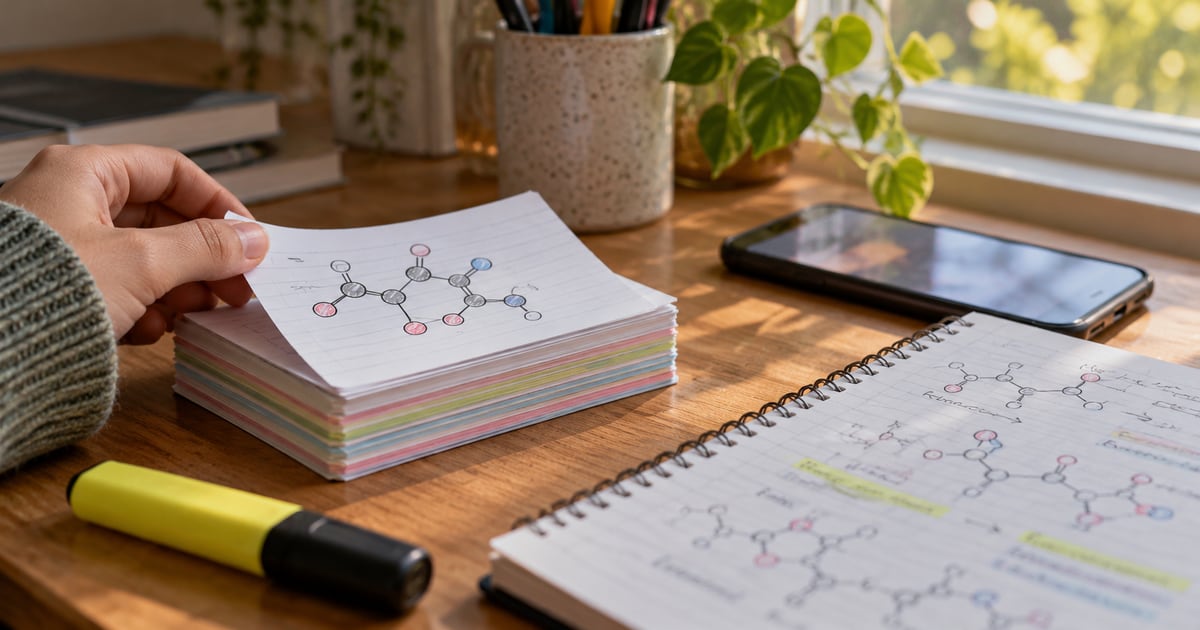


The most common mistake with polyatomic ions is treating them like a phone book: a 30-row table you read top to bottom, over and over, until the night before the test. It feels productive, but rereading a list mostly builds familiarity, not recall. The fix is to memorize far less. About five base ions, one mnemonic and four naming rules let you rebuild most of the table on demand. Then flashcards and short spaced reviews handle the handful of true exceptions. Here is the whole method, with worked examples.
Why polyatomic ions are hard to memorize
Polyatomic ions pack three facts into every entry: a name, a formula and a charge. Miss any one and the compound you write is wrong. Sulfate and sulfite differ by a single oxygen. Nitrate and nitrite differ by one letter in the name. Your brain sees dozens of near-identical items, so they blur together.
There is also a study-habit problem. In a well-known review of ten common study techniques, Dunlosky and colleagues rated rereading and highlighting as low utility, while practice testing and spacing out practice were rated high utility (Dunlosky et al., 2013). A long list invites exactly the low-utility habits.
The good news: the ions follow patterns. Learn the patterns, and the table shrinks.
6 ways to memorize polyatomic ions
1. Memorize five base "-ate" ions with one sentence
Most common oxyanions grow from a few "-ate" ions. A classic mnemonic covers five of them:
"Nick the Camel ate a Clam for Supper in Phoenix."
For each key word, the first letter or two give the element, the number of consonants gives the oxygens, and the number of vowels gives the negative charge.
| Word | Element | Consonants → O | Vowels → charge | Ion |
|---|---|---|---|---|
| Nick | N | 3 (N, c, k) | 1 (i) | NO₃⁻ nitrate |
| Camel | C | 3 (C, m, l) | 2 (a, e) | CO₃²⁻ carbonate |
| Clam | Cl | 3 (C, l, m) | 1 (a) | ClO₃⁻ chlorate |
| Supper | S | 4 (S, p, p, r) | 2 (u, e) | SO₄²⁻ sulfate |
| Phoenix | P | 4 (P, h, n, x) | 3 (o, e, i) | PO₄³⁻ phosphate |
Worked example: a quiz asks for the formula of phosphate. Think "Phoenix": P, four consonants, three vowels. PO₄³⁻. Done in about two seconds.
Why it works: you trade fifteen separate facts (five elements, five oxygen counts, five charges) for one silly, vivid sentence. Bromate (BrO₃⁻) and iodate (IO₃⁻) follow chlorate, since bromine and iodine sit in the same group as chlorine.
2. Derive "-ite" ions instead of memorizing them
An "-ite" ion has one fewer oxygen than its "-ate" partner, with the same charge (LibreTexts).
Worked example:
- Sulfate is SO₄²⁻, so sulfite is SO₃²⁻.
- Nitrate is NO₃⁻, so nitrite is NO₂⁻.
- Chlorate is ClO₃⁻, so chlorite is ClO₂⁻.
Why it works: one rule replaces a whole column of the table. You only store the "-ate" form; the "-ite" form is a quick subtraction.
3. Use "per-" and "hypo-" as one-oxygen steps
Think of the chlorine family as a ladder, with one oxygen between each rung:
| Name | Formula | Step |
|---|---|---|
| perchlorate | ClO₄⁻ | -ate + 1 O |
| chlorate | ClO₃⁻ | base |
| chlorite | ClO₂⁻ | -ate − 1 O |
| hypochlorite | ClO⁻ | -ite − 1 O |
"Per-" means one more oxygen than "-ate". "Hypo-" means one fewer oxygen than "-ite". The charge never changes along the ladder. In intro courses you'll mostly see these prefixes on the halogens (chlorine, bromine, iodine).
Worked example: what is hypobromite? Start at bromate, BrO₃⁻. Bromite drops one oxygen: BrO₂⁻. Hypobromite drops another: BrO⁻.
Why it works: a ladder is a picture, and pictures are easier to retrieve than four separate rows of text.
4. Add hydrogen, raise the charge by one
Many ions come in "hydrogen" versions. Each hydrogen ion (H⁺) you add cancels one unit of negative charge.
Worked example:
- Carbonate CO₃²⁻ → hydrogen carbonate HCO₃⁻ (also called bicarbonate)
- Sulfate SO₄²⁻ → hydrogen sulfate HSO₄⁻
- Phosphate PO₄³⁻ → hydrogen phosphate HPO₄²⁻ → dihydrogen phosphate H₂PO₄⁻
Why it works: it is simple arithmetic you can check. If your answer has hydrogen added but the charge didn't move, you know it's wrong. The older "bi-" prefix simply means "hydrogen", so bicarbonate and hydrogen carbonate are the same ion.
5. Put only the rule-breakers on flashcards
After steps 1 to 4, a short list of ions still doesn't fit any pattern. These are the ones worth flashcards:
| Ion | Formula |
|---|---|
| ammonium | NH₄⁺ (the common positive one) |
| hydroxide | OH⁻ |
| cyanide | CN⁻ |
| acetate | C₂H₃O₂⁻ (also written CH₃COO⁻) |
| permanganate | MnO₄⁻ |
| chromate | CrO₄²⁻ |
| dichromate | Cr₂O₇²⁻ |
| peroxide | O₂²⁻ |
Make each card work both ways: name on the front ("dichromate"), formula and charge on the back; then a second card with the formula on the front. Say the answer out loud before you flip.
Worked example: card front says "MnO₄⁻". You answer "permanganate, minus one", flip, and mark it right or wrong. Wrong cards go back into today's pile.
Why it works: forcing yourself to retrieve an answer strengthens memory more than reading it again. In a study published in Science, students who kept testing themselves on word pairs recalled about 80% a week later, versus about 36% for students who stopped testing once they'd got each pair right (Karpicke & Roediger, 2008). If you want help choosing a tool, see our roundup of the best flashcard apps for iPhone.
6. Space your reviews and use the ions in formulas
Don't drill all the ions in one two-hour block. Review for 10 minutes on several different days instead. A large review of distributed-practice studies found that spreading out study sessions reliably improved long-term recall compared with massing them together (Cepeda et al., 2006).
A simple plan for a test in one week:
| Day | What to do (10–15 min) |
|---|---|
| 1 | Learn the mnemonic and rules 1–4; write the chlorine ladder from memory |
| 2 | Flashcards for the rule-breakers; redo the ladder for bromine |
| 4 | Mixed quiz: 20 random ions, name ↔ formula |
| 6 | Write formulas for 10 compounds (e.g. calcium phosphate) |
| 7 | Quick quiz on only the ions you missed |
Worked example: on day 6, write calcium phosphate. Calcium is Ca²⁺, phosphate is PO₄³⁻. To balance the charges you need three Ca²⁺ (+6) and two PO₄³⁻ (−6): Ca₃(PO₄)₂.
Why it works: using ions inside real formulas forces you to recall the charge, not just the name, which is exactly what exam questions test.
When these tricks aren't enough
Patterns cover the common ions, but not every one. Thiosulfate (S₂O₃²⁻), oxalate (C₂O₄²⁻) and similar ions just need plain repetition. Also check which list your teacher or exam uses: some courses expect a short set, others a long one, and you shouldn't spend time on ions you'll never be asked about.
A quick self-check before any test: cover your notes and write the full chlorine ladder, the five base ions with charges, and the three phosphate forms on a blank page. If you can produce all twelve in under three minutes, the patterns are solid and you can spend the rest of your time on the rule-breakers. If one row keeps failing, that row is your next flashcard.
If you keep mixing up two specific ions, make a card that asks for the difference ("sulfate vs sulfite?") rather than each ion alone. And if you can't explain why hydrogen carbonate has a −1 charge, go back to rule 4 until you can say it in one sentence. Explaining a rule in your own words is a quick way to find the gaps in your understanding.
How Meomy AI can help
If your teacher gave you an ion list as a PDF, you can upload it to Meomy AI and it will turn the content into flashcards and quizzes, so you skip typing every card by hand. Its Feynman AI sessions let you practice explaining a rule, like why per- adds an oxygen, and give you feedback on how clear your explanation was. Real-time feedback and progress tracking show which ions you keep missing, so your next review can focus on those. It's an iPhone app; you'll still get the most out of it by spacing your sessions as described above. You can see more on the Meomy AI app page.
Frequently asked questions
What is the fastest way to memorize polyatomic ions?
Memorize five base -ate ions (nitrate, carbonate, chlorate, sulfate, phosphate) using a mnemonic such as 'Nick the Camel ate a Clam for Supper in Phoenix', then use naming rules to build the -ite, per-, hypo- and hydrogen forms. Put only the true exceptions, like ammonium and acetate, on flashcards.
What is the difference between -ate and -ite ions?
An -ite ion has one fewer oxygen atom than the matching -ate ion, and the charge stays the same. Sulfate is SO4 2- and sulfite is SO3 2-. Nitrate is NO3- and nitrite is NO2-. Learn the -ate form and you get the -ite form for free.
How do I remember the charges of polyatomic ions?
For the base -ate ions, the 'Nick the Camel' mnemonic gives charges: count the vowels in each word to get the negative charge. For hydrogen versions, add 1 to the charge for each hydrogen: carbonate is CO3 2-, hydrogen carbonate is HCO3-. Ammonium, NH4+, is the common positive ion.
Which polyatomic ions should I memorize for chemistry class?
Lists vary by teacher and exam, so check your syllabus first. Most intro courses expect ammonium, hydroxide, nitrate, nitrite, sulfate, sulfite, phosphate, carbonate, hydrogen carbonate, acetate, the chlorine oxyanions, permanganate, chromate, dichromate, cyanide and peroxide.
How long does it take to memorize polyatomic ions?
It depends on how many your course requires, but spreading practice over several short sessions works better than one long one. Research on distributed practice shows spaced sessions lead to better long-term recall than the same time spent in one block, so start a week or more before the test.
Conclusion
You don't need to memorize every polyatomic ion as its own fact. Learn five base ions with "Nick the Camel ate a Clam for Supper in Phoenix", then use four rules: -ite drops one oxygen, per- adds one, hypo- drops one from -ite, and each hydrogen raises the charge by one. Put only the rule-breakers on flashcards, test yourself instead of rereading, and spread short reviews across the week. For more study methods like this one, browse the Meomy AI blog.