
Decimals of Fractions: Free Chart and a 7-Day Practice Plan
A fraction-to-decimal chart for halves through sixteenths, plus a 7-day plan to memorize them. Example: 3/8 = 0.375 and 5/12 = 0.41666… repeating.
 Alic Systems · 9 min read

In this article
You have a worksheet of 30 fractions to turn into decimals, a quiz on Friday, and no calculator allowed. You know the rule is "divide the top by the bottom," but long division for every problem is slow, and 5/12 keeps coming out wrong.
The fix is a reference chart you can trust plus a short daily plan to memorize the fractions that show up most. Below you'll find both: a full chart of the decimals of fractions from halves to sixteenths, the long-division method for anything not on it, and a 7-day practice schedule you can copy.
How to find the decimal of any fraction in 6 steps
A fraction is a division problem: 3/8 means 3 ÷ 8. The Common Core standards ask seventh graders to do exactly this. Standard 7.NS.A.2d says to convert a rational number to a decimal using long division, and to know that the result either ends in zeros or eventually repeats.
1. Simplify the fraction
Reduce to lowest terms first. 6/15 becomes 2/5, which makes the next step honest.
2. Check the denominator
If the simplified denominator's prime factors are only 2s and 5s, the decimal stops. Any other prime (3, 7, 11…) means it repeats. So 7/20 stops (20 = 2 × 2 × 5) and 7/15 repeats (15 = 3 × 5). This works because place values are tenths, hundredths and thousandths, and 10 = 2 × 5.
3. Look for a shortcut to 10, 100 or 1,000
A decimal fraction already has a denominator of 10, 100 or 1,000, so you read it off place value: 7/10 = 0.7, 23/100 = 0.23, 9/1000 = 0.009. If the denominator divides into a power of 10, scale up first: 3/25 = 12/100 = 0.12.
4. Otherwise, set up long division
Write the numerator with a decimal point and zeros, and divide by the denominator. For 3/8: 8 into 30 is 3 (remainder 6), into 60 is 7 (remainder 4), into 40 is 5 exactly. So 3/8 = 0.375.
5. Watch the remainders
For 5/12: 12 into 50 is 4 (remainder 2), into 20 is 1 (remainder 8), into 80 is 6 (remainder 8), and the remainder 8 keeps coming back. As soon as a remainder repeats, every digit after it repeats too, so 5/12 = 0.41666…, written with a bar over the 6.
6. Round only if you're asked to
Check how many places your teacher wants. 2/3 = 0.666… rounds to 0.67 at two places and 0.667 at three.
Why a plan beats cramming
Most students try to learn decimals and fractions in one sitting by drilling one type at a time: all the eighths, then all the ninths. It feels productive, but it trains you to repeat a pattern, not to recognize which fact you need.
Mixing problem types works better. In a study of 54 seventh-grade math classes, Doug Rohrer and colleagues gave some students mixed (interleaved) practice and others blocked practice of one type at a time. On a surprise test a month later, the interleaved group scored 61% against 38% for the blocked group.
The plan below uses that idea. You learn a few families per day, then mix them, and you come back to earlier families instead of leaving them behind.
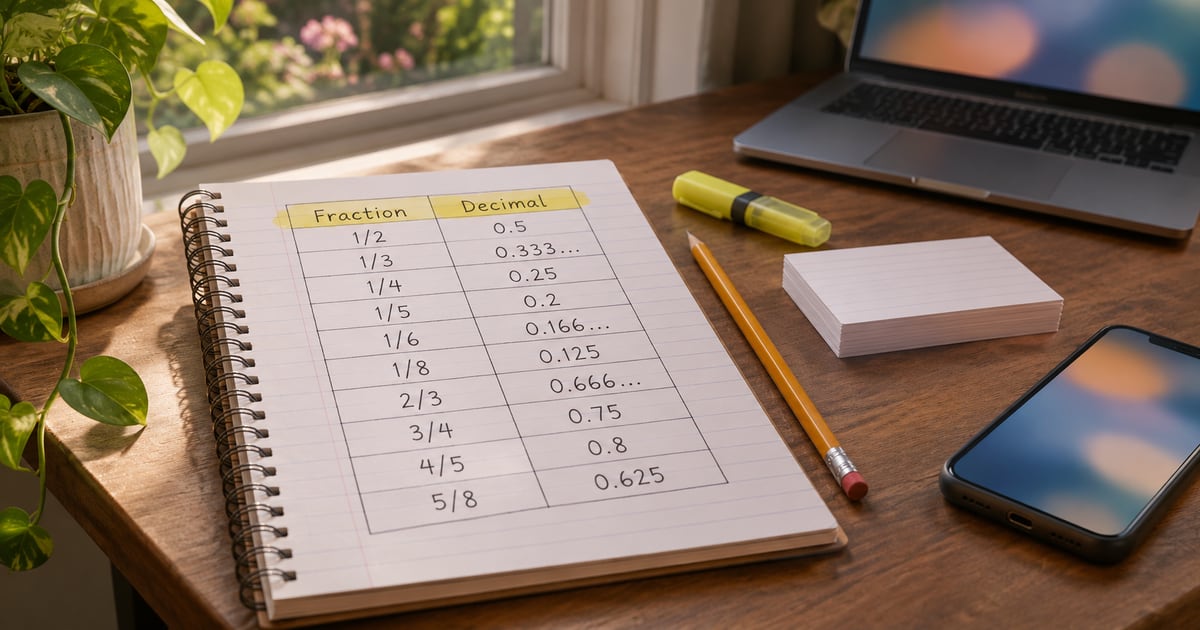
Fraction to decimal chart
Use this as your template: print it, copy it into your notes, or cover the decimal column and quiz yourself. Every fraction is in lowest terms. A dash in the "repeats" column means the decimal stops.
| Fraction | Decimal | Repeats | Percent |
|---|---|---|---|
| 1/2 | 0.5 | — | 50% |
| 1/3 | 0.333… | 3 | ≈ 33.3% |
| 2/3 | 0.666… | 6 | ≈ 66.7% |
| 1/4 | 0.25 | — | 25% |
| 3/4 | 0.75 | — | 75% |
| 1/5 | 0.2 | — | 20% |
| 2/5 | 0.4 | — | 40% |
| 3/5 | 0.6 | — | 60% |
| 4/5 | 0.8 | — | 80% |
| 1/6 | 0.1666… | 6 | ≈ 16.7% |
| 5/6 | 0.8333… | 3 | ≈ 83.3% |
| 1/7 | 0.142857… | 142857 | ≈ 14.3% |
| 2/7 | 0.285714… | 285714 | ≈ 28.6% |
| 3/7 | 0.428571… | 428571 | ≈ 42.9% |
| 4/7 | 0.571428… | 571428 | ≈ 57.1% |
| 5/7 | 0.714285… | 714285 | ≈ 71.4% |
| 6/7 | 0.857142… | 857142 | ≈ 85.7% |
| 1/8 | 0.125 | — | 12.5% |
| 3/8 | 0.375 | — | 37.5% |
| 5/8 | 0.625 | — | 62.5% |
| 7/8 | 0.875 | — | 87.5% |
| 1/9 | 0.111… | 1 | ≈ 11.1% |
| 2/9 | 0.222… | 2 | ≈ 22.2% |
| 4/9 | 0.444… | 4 | ≈ 44.4% |
| 5/9 | 0.555… | 5 | ≈ 55.6% |
| 7/9 | 0.777… | 7 | ≈ 77.8% |
| 8/9 | 0.888… | 8 | ≈ 88.9% |
| 1/10 | 0.1 | — | 10% |
| 3/10 | 0.3 | — | 30% |
| 7/10 | 0.7 | — | 70% |
| 9/10 | 0.9 | — | 90% |
| 1/11 | 0.0909… | 09 | ≈ 9.1% |
| 2/11 | 0.1818… | 18 | ≈ 18.2% |
| 3/11 | 0.2727… | 27 | ≈ 27.3% |
| 4/11 | 0.3636… | 36 | ≈ 36.4% |
| 5/11 | 0.4545… | 45 | ≈ 45.5% |
| 6/11 | 0.5454… | 54 | ≈ 54.5% |
| 7/11 | 0.6363… | 63 | ≈ 63.6% |
| 8/11 | 0.7272… | 72 | ≈ 72.7% |
| 9/11 | 0.8181… | 81 | ≈ 81.8% |
| 10/11 | 0.9090… | 90 | ≈ 90.9% |
| 1/12 | 0.08333… | 3 | ≈ 8.3% |
| 5/12 | 0.41666… | 6 | ≈ 41.7% |
| 7/12 | 0.58333… | 3 | ≈ 58.3% |
| 11/12 | 0.91666… | 6 | ≈ 91.7% |
| 1/16 | 0.0625 | — | 6.25% |
| 3/16 | 0.1875 | — | 18.75% |
| 5/16 | 0.3125 | — | 31.25% |
| 7/16 | 0.4375 | — | 43.75% |
| 9/16 | 0.5625 | — | 56.25% |
| 11/16 | 0.6875 | — | 68.75% |
| 13/16 | 0.8125 | — | 81.25% |
| 15/16 | 0.9375 | — | 93.75% |
Patterns worth noticing:
- Eighths are steps of 0.125: 0.125, 0.25, 0.375, 0.5, 0.625, 0.75, 0.875.
- Sixteenths are steps of 0.0625, so 5/16 = 5 × 0.0625 = 0.3125.
- Ninths repeat their own numerator: 4/9 = 0.444…, 7/9 = 0.777….
- Elevenths repeat 9 times the numerator as a two-digit block: 3/11 → 27 → 0.2727….
- Sevenths all use the same six digits, 142857, starting at a different point.
- Sixths and twelfths start with a non-repeating digit or two, then repeat one digit: 1/6 = 0.1666…, 1/12 = 0.08333….
Your 7-day practice plan
About 10 to 15 minutes a day is enough. Use index cards with the fraction on the front and the decimal on the back, or cover the chart's decimal column.
| Day | Learn | Practice | Mixed review |
|---|---|---|---|
| 1 | Halves, quarters, fifths, tenths | Write each decimal from memory, then check the chart | — |
| 2 | Eighths | Build each eighth by adding 0.125 | 10 random cards from Day 1 |
| 3 | Thirds, sixths, ninths | Do 1/6 and 5/6 by long division once each | Shuffle Days 1–2 cards |
| 4 | Twelfths and elevenths | Use the "9 × numerator" trick for elevenths | Shuffle Days 1–3 cards |
| 5 | Sevenths | Find where each seventh starts in 142857 | Shuffle all cards so far |
| 6 | Sixteenths, plus mixed numbers | Convert 2 3/4, 1 5/8 and 3 1/16 | Timed round: all cards, 3 minutes |
| 7 | Nothing new | Reverse cards: decimal on front, fraction on back | Redo every card you missed this week |
On Day 6, mixed numbers are just the whole number plus the fraction's decimal: 2 3/4 = 2.75, 1 5/8 = 1.625 and 3 1/16 = 3.0625.
Keep a short "missed" pile. Any card you get wrong goes back into the next day's review, even after it leaves its own day.
How to adapt it
The chart and plan are a starting point. Change them to fit the test you're facing.
- Short on time? Squeeze Days 1–3 into one session and spend the rest on mixed review. Halves, quarters, fifths, eighths and thirds cover most everyday problems.
- Studying for percent problems? Add the percent column to your cards. If you're working on word problems, our guide on how to solve percentage word problems shows where these conversions come up.
- Preparing for a bigger test? Fold this week into a longer math study schedule so fractions get reviewed alongside other topics.
- Younger learner? Stop at tenths, quarters and halves for the first week, and use money as the model: 1/4 of a dollar is 25 cents, or $0.25.
Common mistakes
Dividing the wrong way. 3/8 is 3 ÷ 8 = 0.375, not 8 ÷ 3 = 2.666…. A quick check: a proper fraction (top smaller than bottom) always gives a decimal less than 1.
Cutting off a repeating decimal too early. 1/3 is not 0.3. That is 3/10, which is smaller. Write 0.333… or put a bar over the repeating digit.
Rounding down by habit. 2/3 = 0.666…, which rounds to 0.67, not 0.66. Look at the next digit: 5 or more rounds up.
Dropping a placeholder zero. 1/20 is 0.05, not 0.5, and 1/16 is 0.0625, not 0.625. Ask yourself whether the answer is sensible: 1/20 is a small slice, so 0.5 (one half) is far too big.
Reading the digits as the answer. 1/8 is not 0.8 and 1/16 is not 0.16. The digits in the fraction rarely show up in the decimal.
Skipping simplification. 6/15 looks like it should repeat because 15 has a factor of 3. Simplify first to 2/5, and you'll see it is 0.4.
How Math Solver can help
When you are checking a worksheet, Math Solver lets you scan a problem and see the answer with a clear explanation of the steps. That is useful for a stubborn conversion like 7/12 or 5/16, where a slip in the long division is easy to make and hard to spot. Work the problem by hand first, then scan it to compare your steps line by line and find exactly where yours went off track.
It doesn't replace the chart or the 7-day plan. Memorizing the common decimals is what makes you fast on a test without a calculator. Use the app to check your work, and follow your teacher's rules about when apps are allowed. More guides live on the Math blog.

Frequently asked questions
How do you turn a fraction into a decimal?
Divide the numerator by the denominator. For 5/8, work out 5 ÷ 8 by long division: 8 goes into 50 six times with 2 left, into 20 twice with 4 left, and into 40 five times exactly, so 5/8 = 0.625. A calculator gives the same answer instantly.
Why do some fractions become repeating decimals?
Our number system is based on 10, which is 2 × 5. If a fraction in lowest terms has any other prime factor in its denominator, such as 3, 7 or 11, the long division never comes out even. The remainders start to cycle, so the digits repeat, as in 1/3 = 0.333… or 1/7 = 0.142857…
What is 1/3 as a decimal?
1/3 is 0.333…, with the 3 repeating forever. You can write it with a bar over the 3. Rounded, it is 0.33 to two places or 0.333 to three. Writing just 0.3 is a common mistake: 0.3 equals 3/10, which is slightly smaller than one third.
What are decimal fractions?
A decimal fraction is a fraction whose denominator is a power of 10, such as 7/10, 23/100 or 9/1000. These convert straight to decimals by place value: 7/10 = 0.7, 23/100 = 0.23 and 9/1000 = 0.009. Other fractions can be rewritten this way when their denominator divides into a power of 10.
How do you turn a repeating decimal back into a fraction?
Set the decimal equal to x and multiply to shift one full repeat. For 0.2727…, write x = 0.2727…, then 100x = 27.2727…. Subtracting gives 99x = 27, so x = 27/99, which simplifies to 3/11. Check it by dividing 3 by 11.
Conclusion
Finding the decimals of fractions comes down to one move: divide the numerator by the denominator. The quick test tells you before you start whether the answer will stop or repeat: only 2s and 5s in the simplified denominator means it stops. Keep the chart close, learn a few families a day, and mix your review instead of drilling one type at a time. By the end of the week, 3/8 = 0.375 and 5/12 = 0.41666… should come back without long division, and you'll still know how to work out any fraction that isn't on the list.
Keep reading

How to Solve Percentage Word Problems in 7 Steps
Learn how to solve percentage word problems in 7 steps, with worked examples for finding the base, reversing a discount and checking successive changes.

Math Study Schedule: A Free 7-Day Plan Before Any Test
Copy a 7-day math study schedule built on mixed practice and self-testing, with daily times, problem counts and a 45-minute plan for busy days.

Photomath vs Gauth: Which Math Solver App Should You Use?
Photomath vs Gauth compared from their App Store listings: subjects, free steps, paid plans from $11.99 a month, and which app suits which kind of student.