
Sweetgum Tree Identification: 6 Features to Check
Learn sweetgum tree identification with 6 checks for pointed leaves, alternate twigs and spiny fruit, plus tips for separating common look-alikes.
 Alic Systems · 8 min read

In this article
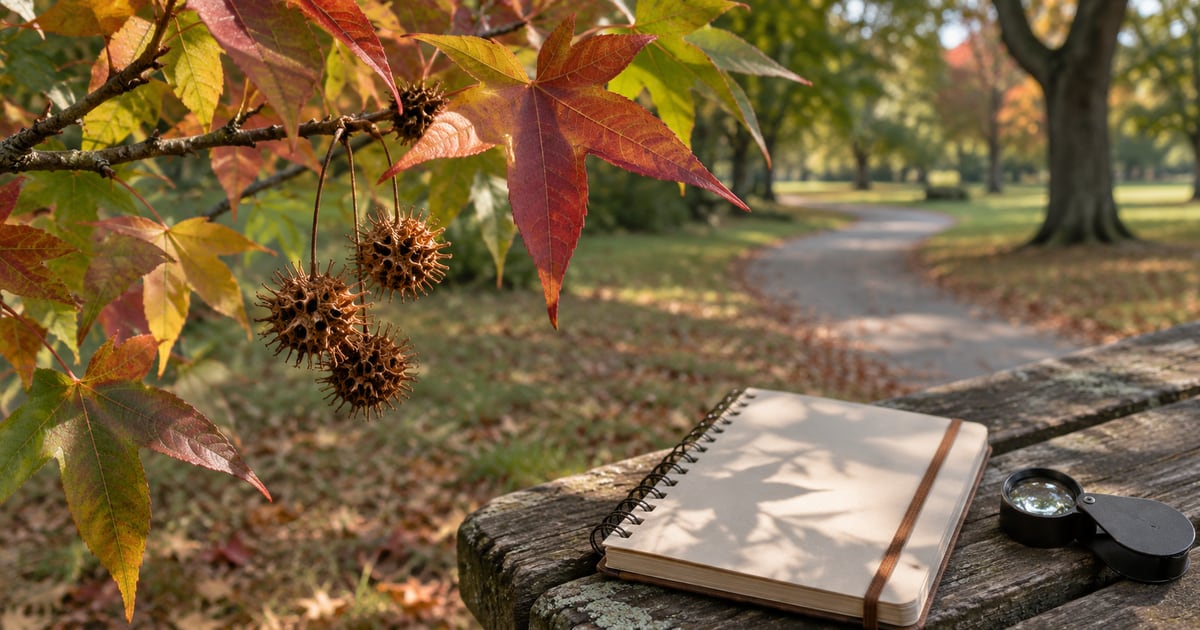
A sweetgum’s spiky ball is a cluster of many seed capsules, according to the Texas A&M Forest Service. Those clusters can remain on twigs into winter, when the familiar star-shaped leaves are gone. For sweetgum tree identification, look for a combination of alternate, pointed leaves and round, spiny fruit attached to the same tree. If one feature is missing, check the others and record what you still need to see. Texas A&M Forest Service sweetgum profile
What an American sweetgum looks like
American sweetgum, or Liquidambar styraciflua, is a deciduous tree with simple leaves whose main veins radiate out into pointed lobes. A leaf often looks like a star. The resemblance is a useful clue, but a closer look shows small teeth along the margins and the way each leaf attaches separately along the twig. NC State Extension plant profile
Start with the whole tree, then look for details you can connect to it. If a sidewalk holds several kinds of fallen leaves and fruit, it may be difficult to tell which tree dropped which object. A branch you can see clearly can give you a stronger comparison than a collection of objects beneath it.
Keep two views when you can. A wide photograph shows the canopy and surrounding trees, while a close photograph shows whether a fruit hangs from a twig or a leaf attaches opposite another leaf. If the branches are out of reach, photograph from where you can stand safely and leave uncertain details open.
This guide focuses on American sweetgum. Other trees can share a common name or some of its visual features. Use a reference appropriate to the region, particularly when the tree is planted in a collection with species from several parts of the world.
6 features to check
1. Look at the pointed lobes and toothed edges
Find a complete leaf with the tip and edges visible. Texas A&M describes American sweetgum leaves as typically having five to seven pointed lobes and finely toothed margins. The lobe pattern is easiest to see when the whole leaf lies in one plane in the image.
If you find a single star-shaped leaf, examine whether its main veins spread toward several pointed tips. Then zoom in on the margin. A close crop of one tip may show the teeth but hide the overall shape, so keep the original full-leaf view as well.
In field notes, write “five pointed lobes, fine teeth visible” if that is what you saw. If the leaf is torn, record which portions are missing before trying to count lobes. Some leaves on a tree can vary, so check more than one when available.
2. Follow the leaf stalks along a twig
Look at where the stalks join the twig, rather than at which way the broad leaves happen to face. In an alternate arrangement, the attachment points occur one at a time along the twig. In an opposite arrangement, two attachments occur across from one another at the same level.
A leaf can twist toward the light or overlap its neighbour in a photograph. Follow the stalks to their bases before deciding that two leaves form a pair. The Smithsonian specifically highlights alternate arrangement as a way to distinguish sweetgum from maples. Smithsonian sweetgum collection notes
If the photograph only shows a detached leaf, mark this check as unknown. The missing attachment cannot be reconstructed from the silhouette. A second view that includes a short stretch of twig may be more valuable than a sharper crop of the original leaf.
3. Look for the round, spiny fruit cluster
The fruit cluster looks like a woody ball with projecting points. NC State's wetland plant guide describes it as about two to three centimetres wide. Compare a clear photograph of its structure with the guide, and look for the stalk if the cluster is still hanging. NC State wetland plant guide
If you only see balls on the ground, take a wider photo that includes nearby trunks and canopies. Look above for a matching cluster attached to a twig. The ground fruit supports a local possibility, while the attached cluster helps establish which tree produced it.
A simple record might read “three spiny clusters below two trees, none seen attached.” That wording is more useful than immediately assigning all three to the closest trunk. You can return later and photograph additional evidence when light or branch position makes it visible.
4. Inspect bark and corky ridges as supporting clues
A mature trunk can show furrowed bark. Some sweetgum branches also develop corky ridges. The Smithsonian notes that those ridges can be absent, so their absence alone does not settle the question. Bark and twig features are most useful alongside evidence from leaves or fruit.
Take a trunk photograph from a distance that shows the pattern, then take a closer view of a twig if one is already visible. Label the pictures separately. A trunk furrow and a corky projection on a small branch describe different surfaces.
If the only available photograph is a tight crop of bark, use the result as a candidate for later checking. Ask what leaf or fruit feature would strengthen the identification. Bark can guide your next observation without requiring you to assign a species from one view.
5. Use the season to choose the next feature
In the growing season, leaf shape and attachment can be checked together. In autumn, the Texas A&M profile describes colours ranging from yellow and orange to red and purple. Treat colour as a cue to look closer. Other deciduous trees can have similar colours.
In winter, look for persistent fruit clusters first, then check twig and bark details. If fruit is absent, keep the identification tentative. Take a wide photo and note the location so you can revisit the same tree after it leafs out.
A repeat visit is especially useful when the first clue came from the ground. Compare the new observation with your original notes and update your confidence based on what is visible on the tree. A date beside each image helps you keep seasonal changes in order.
6. Compare the whole tree and record where it grows
Texas A&M describes younger sweetgums as often conical and older trees as having broader crowns. The outline gives context, though pruning and the available space can change what a planted tree looks like. Use the crown to describe your observation and the smaller details to narrow the identification.
Write down the region, the date and whether the tree appears to be planted in a street, park or collection. Geographic context helps when comparing similar plants. A planted specimen may appear outside the places where a local guide normally discusses it.
A compact field record might say “park tree, several pointed leaves with alternate stalks, bark furrowed, spiky fruit attached.” Each observation can then be checked against a reference. If you are uncertain whether two photographs show the same tree, keep them separate until you can verify the connection.
Look-alikes
Maples. Begin with the twig. A maple's opposite arrangement contrasts with sweetgum's alternate leaves. Maples also produce winged fruits rather than sweetgum's woody, spiny clusters. Compare those features before relying on a similar lobed outline. NC State common tree identification guide
American sycamore. A round fruit head can invite comparison. Texas A&M distinguishes sycamore by its shallow leaf lobes and distinctive peeling bark. If you see only a ball at a distance, look for the leaf and bark combination before settling on either tree.
Winged elm. The NC State wetland guide notes that corky twig growth can cause confusion in winter. It describes winged elm's projections along two sides in one plane. In a close view, record how the growth is arranged, and seek another feature when the twig alone is ambiguous.
The same principle applies to other tree comparisons. The red oak and white oak guide illustrates how a set of visible clues gives you more to check than a single familiar-looking feature. Use the details that distinguish the specific pair in front of you.
When to ask an expert
Ask an extension office, arboretum or experienced local observer when you only have bark photos, the detached material cannot be tied to a trunk, or your features point in different directions. Share the original photographs, region and date. Say which details were attached to the tree and which were on the ground.
For example, write “alternate leaves seen on the low branch, round fruit found between this tree and its neighbour.” That distinction gives a reviewer a clear uncertainty to address. If an identification would inform tree work or another consequential decision, have a qualified person evaluate the tree.
For more context on photo suggestions and reference tools, see the tree identification app comparison. Keep an uncertain record tentative until you have features you can compare with a regional source.
How Plants & Tree can help
Plants & Tree offers photo-based suggestions for trees and wood, along with reference information and saved identification history. A clear leaf or bark photo can give you a candidate name to investigate. Keep a separate photograph of the twig and any attached fruit so you can compare features independently.
If the app suggests American sweetgum, check whether the visible traits support that possibility. Save the observation for later review when some parts are missing, particularly in winter. Use a regional reference or ask an expert if the available details cannot separate similar trees.

Frequently asked questions
How can I recognize a sweetgum leaf?
Look for several pointed lobes spreading from the leaf's centre and fine teeth along the edge. Follow its stalk to the twig and check whether leaves attach one at a time along it. A detached leaf alone cannot show the arrangement.
What are the spiky balls on a sweetgum tree?
They are fruiting clusters made up of many seed capsules. They can stay attached on stalks into winter. If you see them on the ground beneath several trees, look for a matching cluster on a branch to connect the fruit to the right tree.
How do you distinguish sweetgum from maple?
Check leaf arrangement and fruit. American sweetgum has alternate leaves and round, spiny fruit clusters, while maples have opposite leaves and winged fruits. Compare the twig itself, since overlapping leaves in a photograph can make their attachment points hard to see.
Can I identify sweetgum after its leaves fall?
Look for fruit clusters still attached to the tree and use bark and twig details as supporting evidence. When those features are missing or unclear, photograph the tree and record its location so you can compare it again when leaves return.
Conclusion
Start with star-shaped, toothed leaves, then check how their stalks attach along the twig. Look for a round, spiny fruit cluster connected to the same tree. Use bark and season as supporting evidence and record when a detail is hidden or missing. If only fallen material is visible, photograph its setting and return for an attached leaf or fruit before assigning a confident name.
Keep reading

How to Tell If Wood Is Veneer: 6 Nondestructive Checks
Learn how to tell if wood is veneer using 6 visual checks, component notes and existing edges, plus when to stop and ask a furniture specialist for help.
Red Oak vs White Oak: 5 Ways to Tell the Trees and Wood Apart
How to tell red oak from white oak by leaf lobes, acorns, bark and end grain, plus why white oak pores hold about 7 times more tylose plugs.

PlantNet vs iNaturalist: Which Is Better for Identifying Trees?
PlantNet vs iNaturalist for trees: both are free, but iNaturalist won't make a planted street tree Research Grade. See which app fits your walk.