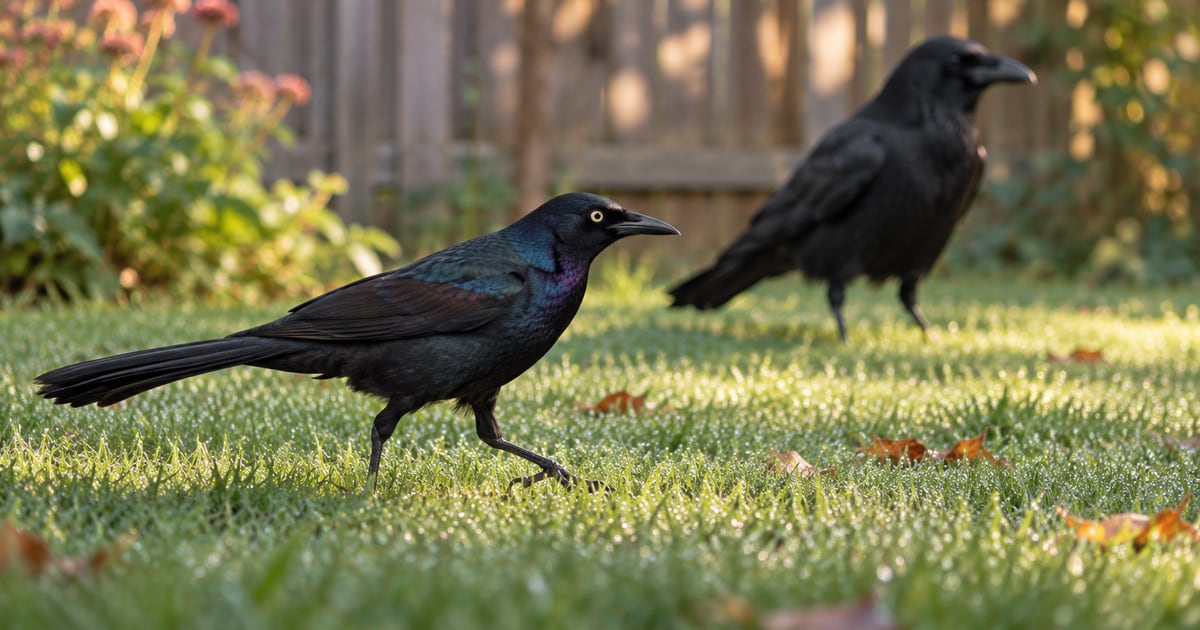


Here is the fact that trips people up: a male Great-tailed Grackle can measure 18 to 23 inches from bill to tail, according to the Audubon field guide. An American Crow measures 16 to 21 inches. So in Texas and the Southwest, the "big black bird" on the parking lot light might be longer than a crow and still not be one. Length fools you because so much of a grackle is tail. The body tells the truth: that same grackle weighs under 10 ounces, while a crow can top 20. Once you stop judging by length, the two birds are easy to separate.
Quick answer: how to tell them apart
Check three things, in this order:
- The eye. An adult grackle has pale yellow eyes you can see from across a yard. A crow's eye is dark.
- The tail. A grackle's tail is long and folded into a V or keel. A crow's tail is short and square at the end.
- The shine. In sunlight, a grackle's head flashes blue, purple or bronze. A crow stays flat black.
If two of the three point the same way, you have your answer. The rest of this guide covers the trickier cases: young birds, females, birds in moult and birds seen only in flight.
| Feature | American Crow | Common Grackle | Great-tailed Grackle (male) |
|---|---|---|---|
| Family | Corvidae (crows and ravens) | Icteridae (blackbirds) | Icteridae (blackbirds) |
| Length | 16–21 in | 11–13.4 in | 18–23 in |
| Wingspan | 34–39 in | 14–18 in | 20–24 in |
| Weight | 11–22 oz | 2.6–5 oz | 6.7–9.4 oz |
| Adult eye | Dark brown | Whitish-yellow | Yellow |
| Feathers | Flat black | Glossy, blue-purple or bronze head | Glossy black, even gloss |
| Tail | Short, square-tipped | Long, creased down the middle | Very long, oversized |
| Main call | Caw-caw | Squeaky "rusty hinge" | Whistles, clucks, hisses |
Measurements are from the Audubon field guide pages for the American Crow, Common Grackle and Great-tailed Grackle.
Key differences, one clue at a time
Each of these clues works on its own, but two together are far more reliable than one.
1. Eye colour
This is the fastest test when the bird is close. Adult Common Grackles have whitish-yellow eyes, and Great-tailed Grackles have yellow eyes. Against black feathers they look almost white, giving the bird a staring expression.
Adult American Crows have dark brown eyes that disappear into the face. Stanford's bird essays note that young American Crows start with blue or blue-grey eyes that turn brown as they age.
The catch: juvenile grackles also have dark eyes. In summer and early autumn, a dark-eyed black bird on your lawn could be a young grackle. Use the tail and size to confirm.
2. Tail shape
Watch the bird walk away from you or fly overhead.
A Common Grackle's tail is long for its body and has a crease down the middle, so the two halves tilt up like the hull of a boat. Mass Audubon describes it as often looking keel-shaped in flight. A male Great-tailed Grackle's tail is even more dramatic, often looking almost as long as the rest of the bird.
A crow's tail is relatively short and square-tipped. When a crow flies over, the tail looks like a neat fan with a flat end.
The catch: in late summer, moulting grackles can have short or ragged tails. A grackle with half a tail looks surprisingly crow-like, so check the eye before you decide.
3. Gloss and colour
Stand where the sun is behind you. A grackle's feathers are iridescent. Common Grackles show a blue or purple head, and in much of their range a bronze body that contrasts with the head. In the Southeast, a purple form shows purple and green gloss instead.
Crows are black all over, with sexes alike. They can look a little glossy in strong light, but they never show the clear two-tone head and body of a Common Grackle.
Female Great-tailed Grackles are a separate puzzle. They are smaller than males and buffy brown below with a pale eyebrow. Nobody mistakes them for a crow, but people often don't realise they're grackles at all.
4. Size and build
Size is useful, but only if you think in weight and wingspan rather than length.
- An American Crow weighs 11 to 22 ounces. Mass Audubon calls it "almost as large as a chicken."
- A Common Grackle weighs 2.6 to 5 ounces. Mass Audubon compares it to a robin.
- A male Great-tailed Grackle sits in between at 6.7 to 9.4 ounces, despite its length.
In practice, a crow looks thick-necked and heavy-chested, with a strong, deep bill. A grackle looks slim and long, with a narrower, pointed bill. If you see the two birds side by side, the crow's wings look far broader: up to 39 inches across, against 14 to 18 inches for a Common Grackle.
5. Voice
Often you hear these birds before you see them.
- Crow: the classic caw-caw or caa-caa, flat and falling.
- Common Grackle: a harsh, high, squeaky call like a rusty gate hinge. Males also give creaky, grating songs from treetops.
- Great-tailed Grackle: a loud mix of whistles, clucks and hissing notes, very different from a caw.
If the bird says "caw," it is a crow (or a raven, which is a different comparison). Anything that squeaks, whistles or clicks is very likely a grackle.
6. Behaviour and habitat
Both birds feed mostly on the ground, on lawns, fields and roadsides, so behaviour overlaps more than people expect. A few habits still help:
- Grackles walk with deliberate steps across lawns hunting insects, and sometimes wade in very shallow water. They nest in colonies, typically 10 to 30 pairs, in dense trees near open ground.
- Crows are wide-ranging scavengers. They search roadsides and dumps, and Audubon notes they will carry hard-shelled molluscs into the air and drop them onto rocks to crack them.
- Both gather in large communal roosts in late summer through winter, so a big evening flock doesn't settle the question by itself.
Still not sure?
Some sightings won't give you a clean answer: a silhouette against a grey sky, a bird in heavy moult, a dark-eyed youngster. A few habits make the next try easier.
Get a photo with the light behind you. Gloss and eye colour only show in good light. Even a blurry phone shot can show a pale eye.
Note the location. Great-tailed Grackles are birds of Texas, the Southwest and the Rocky Mountain region, though Audubon notes their range is still spreading north. Mass Audubon notes the Common Grackle is the only grackle that breeds in Massachusetts, so a huge long-tailed grackle in New England would be an unusual record worth double-checking.
Ask people who know local birds. Your local Audubon chapter, a birding group or community science platforms can confirm a tricky photo. We compared two popular free options in Seek vs iNaturalist.
Watch, don't handle. Crows and grackles are both covered by the U.S. Migratory Bird Treaty Act, and you don't need to touch or approach either to identify it. If you find an injured bird, contact a licensed wildlife rehabilitator rather than handling it yourself.
How Species ID can help
Species ID is an iPhone app that suggests what an animal is from a photo you take or upload. For a black bird on the lawn, it gives a likely name plus a species profile covering diet, habitat, behaviour and natural range, which helps when you're weighing a Common Grackle against a Great-tailed one. Each find is saved to your personal wildlife log, so you can track which of the two visits your yard and when.
Treat the result as a strong suggestion, not a final verdict. Check it against the eye, tail and voice tests above, especially for juveniles or moulting birds. For more look-alike guides, browse the Species ID blog.
Frequently asked questions
Is a grackle a type of crow?
No. Grackles belong to the New World blackbird family, Icteridae, the same family as Red-winged Blackbirds and orioles. Crows and ravens belong to Corvidae. The two look alike because both are mostly black, ground-feeding birds that do well around people, not because they are close relatives.
Which is bigger, a crow or a grackle?
A crow, by weight and wingspan. An American Crow weighs 11 to 22 ounces with a 34 to 39 inch wingspan. A Common Grackle weighs 2.6 to 5 ounces. A male Great-tailed Grackle can match a crow in length, but most of that length is tail, and it weighs well under a crow.
Do crows have yellow eyes?
No. Adult American Crows have dark brown eyes that barely show against their black face. Young crows have blue-grey eyes that darken with age. Pale yellow eyes on a black bird in North America point to a grackle, though young grackles have dark eyes too.
What does a grackle sound like compared to a crow?
A crow gives the familiar flat caw. A Common Grackle makes harsh squeaks often compared to a rusty gate hinge. Great-tailed Grackles add loud whistles, clucks and hissing notes. If the bird is calling, voice alone often settles it.
Why do grackles and crows gather in huge flocks?
Both form communal roosts, especially from late summer through winter. Common Grackles fly in big evening flocks toward shared roost trees, and American Crows can gather in the thousands in one grove on winter nights. A flock alone won't tell you which bird it is.
Conclusion
Crows and grackles share the colour black and not much else. They come from different families, and the clues are consistent once you know where to look. Adult grackles have pale eyes, glossy heads and long creased tails. Crows have dark eyes, flat black feathers, short square tails and far heavier bodies. Skip length, which a Great-tailed Grackle's tail can inflate, and judge by bulk, eye and voice. When a bird is young or moulting, combine two or three clues before you decide.