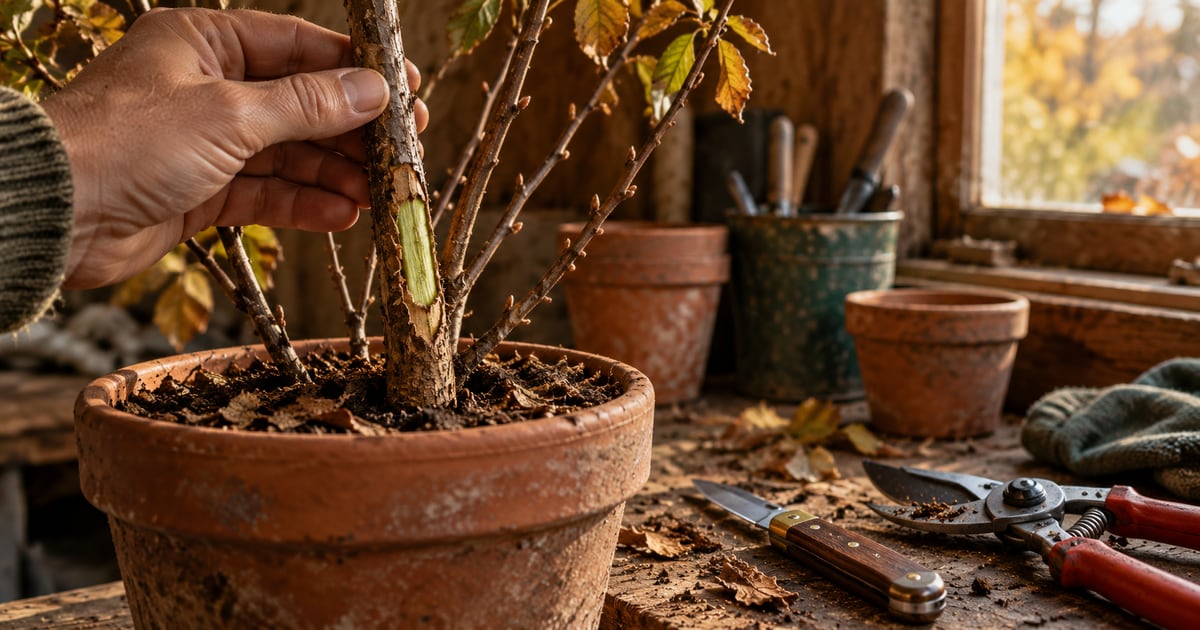
The most common mistake with a plant that looks dead in autumn or winter is throwing it away too soon. Bare stems, a pot of dry-looking sticks, or bulbs that have collapsed into brown straw all look like failure. Very often, though, the plant is only resting. Dormancy is a normal pause in growth, and from the outside it can look almost exactly like death. The fix is simple: test before you toss. Six quick checks, most of them done with your fingernail, will tell you whether there is still living tissue to work with.
Why dormant plants get mistaken for dead ones
Dormancy and death share the same surface signs. Leaves drop or brown, growth stops, and the plant stops responding to water. The difference is all on the inside, in the thin living layer under the bark and in the roots.
There are three common situations where this mix-up happens:
- Deciduous trees and shrubs in winter. They drop every leaf on purpose. A bare hydrangea or young fruit tree can look like a dead stick until spring.
- Bulbs and some perennials after flowering. Spring-flowering bulbs grow over winter, flower in spring and then go dormant in summer, so their foliage yellows and flops. University of Georgia Extension advises leaving that foliage until it dies naturally, usually by late spring or early summer, because green leaves are still storing food for next year.
- Houseplants in winter. Most don't go fully dormant, but NC State Extension notes that growth significantly decreases in winter, so a plant that sits still for months may simply be slow, not sick.
Cold damage and drought add to the confusion. New Mexico State University's horticulture team points out that branches hit by winter cold or drought may be injured, but not dead, and can leaf out late.
6 tests to tell dead from dormant
Start with the scratch test if the plant has woody stems, and with the root check if it's a soft-stemmed houseplant in a pot. Run more than one test. Each one checks a different part of the plant, and together they give you a far clearer picture than any single sign.
1. The scratch test
This is the most reliable check for woody plants. Use a fingernail or a clean pocketknife to scrape away a tiny patch of bark on a young stem, about the size of a fingernail.
- Green and moist underneath: that section is alive.
- Brown or grey and dry: that section is dead.
The green layer is the cambium, the living tissue just under the bark. NMSU's guidance is clear: a living branch shows green cambium, while brown or grey cambium means the branch is dead.
Worked example: you scratch the tip of a rose cane in March and find brown. Don't stop there. Scratch again halfway down, then just above the soil. If the lower scratch is green, the cane died back partway and the rest is alive. You'd prune to just above the green section once growth starts.
2. The bend test
Take a thin twig between your fingers and bend it gently. Live wood is usually flexible and springs back. Dead wood tends to be dry, brittle and snaps cleanly with little effort, often showing a dry, hollow-looking centre.
This test is fast but rougher than the scratch test. Very thin twigs can snap even when alive, and some stems are naturally stiff. Use it to decide where to scratch, not as the final word.
3. Check the buds
Look closely along the stems for buds, the small bumps where new leaves or flowers will appear. On a dormant plant they're usually firm and plump, even in winter. On dead wood they're often shrivelled, dry, or missing entirely.
If you gently pinch a bud open, a living one is usually green or pale and moist inside. A dead one is brown and crumbles. Check several buds on different stems, because one branch can die while the rest of the plant is fine.
4. Look at the roots and crown
For potted plants, this check settles most cases. Slide the plant out of its pot and look at the roots. Iowa State University Extension describes healthy root tissue as firm, white, and showing numerous feeder roots. Rotted roots, by contrast, are mushy and brown or reddish.
Then check the crown, the point where stems meet the soil. A firm crown, especially one with tiny new shoots tucked against it, is a strong sign of life. A soft, collapsing crown that smells sour usually means rot.
If you find mushy roots, the plant isn't dormant: it has a problem. Our guide on how to identify root rot walks through the signs in detail.
For plants in the ground, you don't need to dig the whole thing up. Gently brush away soil at the base and look at the crown and the top of the roots instead.
5. Match the timing to the plant
Ask whether this plant is supposed to look like this right now. A few questions help:
- Is it deciduous? Then bare branches in winter are normal.
- Is it a spring bulb or early perennial? Then dying foliage in late spring or early summer is normal.
- Is it a houseplant in a dim winter window? Then slow or no growth is normal, but heavy leaf drop with soft stems is not.
Worked example: your daffodil leaves turn yellow and flop over in May. That's right on schedule. The same yellowing on a peace lily in July, in a warm room, points to a care problem instead, so look at watering and roots.
6. The wait-and-watch test
If the other tests show any life, the last test is patience. Mark a few stems with a twist tie, cut back on water, and check every week or two.
- Keep potted plants somewhere with steady light and no cold drafts.
- For most houseplants in winter, let the soil nearly dry out between waterings.
- Hold off on fertiliser until growth starts again. NC State suggests resuming in March or April.
How long should you wait? For deciduous shrubs and trees, give them until well into spring, after similar plants nearby have leafed out. Late starters are common after a cold winter, and NMSU notes that injured branches can leaf out more slowly than healthy ones. For houseplants, a few weeks of brighter light in early spring is usually enough to show whether the plant will respond.
When new growth appears, it shows you exactly where the live wood is. Then you can prune dead sections with confidence instead of guessing.
When home tests aren't enough
Some situations call for more than a fingernail and a calendar:
- Large trees. A big tree that fails to leaf out, or drops limbs, can be a safety risk. Ask a certified arborist to inspect it rather than climbing or cutting it yourself.
- Spreading symptoms. If you see spots, fuzzy growth, or wilting moving from plant to plant, you may be dealing with a disease or pest. Your local cooperative extension office can often help identify samples.
- Mixed results. Green under the bark but mushy roots, or healthy roots with no buds anywhere, usually mean the plant is alive but struggling. That's a care problem to solve, not a dormancy to wait out.
- Valuable or sentimental plants. A local nursery or extension master gardener can look at the plant in person and catch details a photo can't.
How Plant Disease Identifier can help
If your tests show the plant is alive but something still looks wrong, Plant Disease Identifier can give you a starting point. Snap a photo to identify the plant, which helps you check whether it's a species that normally goes dormant, and to spot possible diseases along with general care tips. Treat any result as a suggestion to check, not a final diagnosis.
Once you know what you're dealing with, care reminders can help you water less often while the plant rests and pick up again in spring. You can find more plant health guides on the Plant Disease Identifier blog.
 Plant Disease IdentifierIdentify plants and spot possible plant diseases from a photo, with care tips and reminders.

Frequently asked questions
How long can a plant stay dormant?
It depends on the plant. Deciduous trees and shrubs usually rest through winter and leaf out in spring, while spring bulbs such as tulips die back in late spring and stay dormant until the following year. Houseplants rarely go fully dormant, but their growth slows down a lot in winter.
Should I water a dormant plant?
Yes, but much less. A resting plant uses less water, and wet soil around inactive roots invites rot. For most houseplants in winter, let the soil nearly dry out between waterings. Outdoor plants in the ground usually need only occasional water during dry spells.
Can a plant with all brown leaves come back?
Often, yes. Brown leaves only tell you the leaves are dead. If the stems are flexible and green under the bark, or the roots are still firm and white, the plant can push out new growth once conditions improve. Trim off the dead leaves and keep checking.
Is it dead or dormant if the stem is brown inside?
A brown, dry layer under the bark means that section of stem is dead. Scratch again lower down, near the soil. Many plants die back from the tips while the base and roots stay alive, so one brown spot is not proof the whole plant is gone.
When should I cut back dead-looking branches?
If you're not sure, wait until the plant starts growing again in spring. New buds will show you exactly where live wood ends. Then cut back to just above healthy growth. Branches that are clearly broken or diseased can be removed at any time.
Conclusion
A plant that looks dead is often just resting. Before you throw it out, scratch the bark, bend a twig, look at the buds and check the roots. Green tissue, plump buds or firm white roots all mean there's still life to work with. Then match what you see to the plant's natural rhythm and give it a few weeks with less water and no fertiliser. If new growth appears, prune back to it. If every test comes up brown, dry and mushy, you can let it go knowing you checked properly.