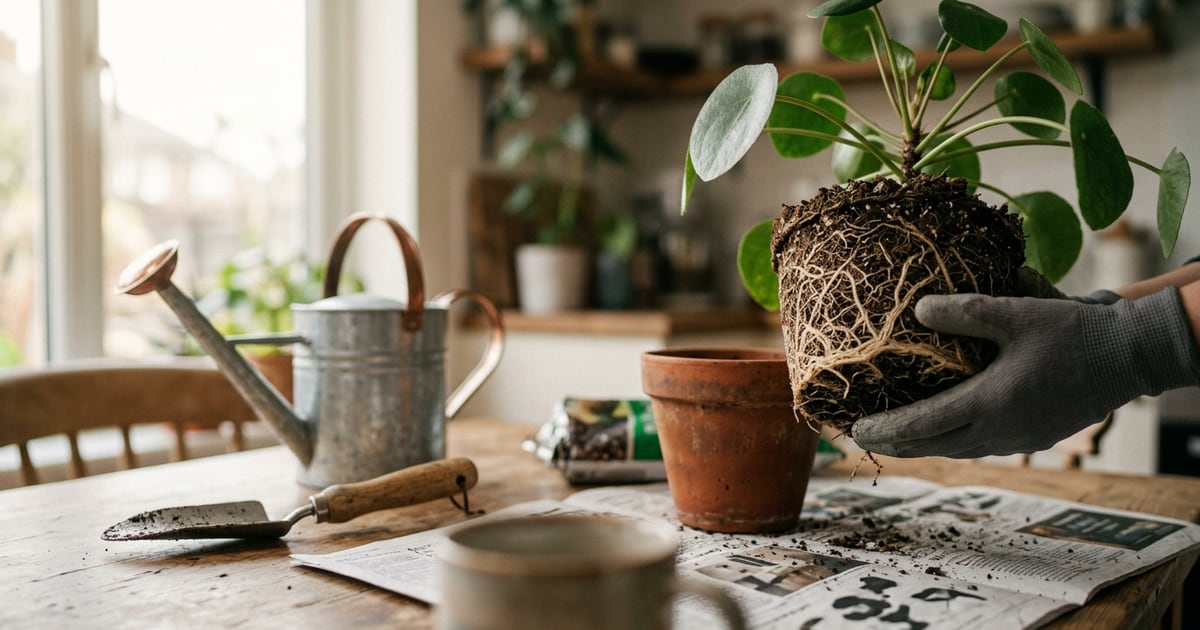
Root rot shows up in the roots first, so the only reliable way to identify it is to take the plant out of its pot and look: healthy roots are firm and white or pale, while rotted roots are brown to black, soft and often smelly. That matters because the above-ground signs, like wilting and yellow leaves, look almost exactly like a thirsty plant. Many people water a rotting plant even more, which makes things worse. Learning the signs below helps you catch the problem while there are still healthy roots left.
What root rot looks like
Root rot isn't one disease. It's a name for decay caused by several soil-borne organisms, including Pythium, Phytophthora, Rhizoctonia and Fusarium. According to Iowa State University Extension, these organisms thrive in wet, poorly drained soil and potting mix and attack plants that are already stressed or weak.
So the setting is usually the same: a pot that stays soggy, a saucer full of water, heavy garden soil, or a container with no drainage hole.
Here's the contrast to keep in mind:
- Healthy roots: firm, white or cream (some plants have tan or orange roots naturally), with lots of fine feeder roots.
- Rotted roots: brown, reddish or black, soft or mushy, sometimes slimy, with few or no fine roots.
Iowa State describes healthy root tissue as "firm, white, and show numerous feeder roots," and rotted roots as "mushy" with "a brown or reddish color." That one comparison does most of the work. The seven signs below help you decide when to look and how to read what you find.
7 signs to check
Work through these in order. The first three you can check without disturbing the plant; the rest need the root ball out of the pot.
1. Wilting while the soil is still wet
This is the classic warning sign. A plant that droops after a drink is behaving strangely. University of Wisconsin–Madison Extension notes that gardeners often notice root rot when a plant is wilted "even though the soil is wet."
How to check: push a finger 2–3 cm (about an inch) into the potting mix, or lift the pot to feel its weight. If it's damp and heavy and the plant still sags, the roots probably can't take up water.
2. Lower leaves yellowing and dropping first
Root rot usually starts from the bottom of the plant. Iowa State says symptoms "begin with wilting of bottom leaves that may progress upward until total plant collapse."
How to check: look at the oldest leaves near the soil. Yellow, limp or dropping lower leaves, combined with sign 1, point toward the roots. Yellowing that starts at the top or on new growth more often has a different cause.
3. Slow growth and pale or reddish leaves
Rotting roots can't feed the plant properly, so growth stalls. UW–Madison Extension notes that affected plants may be stunted, with yellow or red leaves that can be mistaken for a nutrient problem.
How to check: compare this season's growth with last season's. If new leaves are smaller and paler, and feeding hasn't helped, the cause may be underground.
4. Brown, soft or mushy roots
Now slide the plant out. Tip the pot on its side, support the base of the stems, and ease the root ball free. Gently shake or rinse off loose soil so you can see the roots clearly.
What to look for: roots that are brown to black and soft to the touch. University of Maryland Extension describes Pythium-affected roots as "brown to black and soft or mushy." Firm roots that are simply stained by dark soil are fine; squeeze gently to tell the difference.
5. An outer layer that slides off
This is one of the most telling tests. Pinch a suspect root between finger and thumb and pull gently. On a rotted root, the outer layer (the cortex) slips away, leaving a thin, stringy core behind. Purdue Extension describes roots where "the root cortex easily sloughs off, leaving a strand of vascular tissue."
Worked example: imagine a peace lily that has drooped for a week despite regular watering. You unpot it and find a dense mat of dark roots near the bottom. You pinch one and the brown skin slides off like a sleeve, leaving a pale thread. That's a strong root rot sign. A few roots near the top that stay firm and white are the healthy part you'd want to keep.
6. A sour or rotten smell
Sniff the root ball. Healthy potting mix smells earthy. Decaying roots often don't: UW–Madison Extension notes that affected roots "may have a bad odor." A sour, musty or sewage-like smell, especially from waterlogged mix, is a useful clue on its own.
7. Rot starting at the tips or the base of the stem
Note where the damage is. Maryland Extension notes that Phytophthora tends to turn root tips dark brown before they rapidly go soft. In other cases the decay creeps up into the crown, the point where stems meet the soil, which turns dark and soft.
How to check: press gently on the base of the stems. If it feels squishy or the stems wobble loosely in the pot, the rot has likely moved beyond the roots.
Look-alikes
Several problems can mimic root rot from above. Rule these out before deciding:
| Problem | How it looks | How to tell it apart |
|---|---|---|
| Underwatering | Wilting, dry crispy leaf edges | Soil is dry and light; roots are firm and pale |
| Root-bound plant | Wilting, slow growth, water runs straight through | Roots circle the pot in a tight mat but are firm and light-coloured |
| Fertilizer salt build-up | Brown leaf tips, white crust on soil or pot rim | Roots may be damaged at tips but not mushy throughout |
| Cold or transplant shock | Sudden droop after a move or a cold draught | Recent change in conditions; roots look healthy |
| Fungus gnats | Tiny flies around damp soil | Gnats point to wet soil but aren't rot themselves; check roots anyway |
| Natural root colour | Tan, orange or dark roots | Some plants have coloured roots naturally; they stay firm when squeezed |
The squeeze test is your best tie-breaker. Coloured but firm roots are usually fine. Soft roots with a slipping outer layer usually are not.
When to ask an expert
Home checks tell you that roots are rotting, but not which organism is doing it. Purdue notes that root rot symptoms look surprisingly similar regardless of the cause, and Iowa State says microscopic examination or lab isolation is needed to name the specific fungus. As UW–Madison puts it, "very few diseases can accurately be diagnosed by eye."
Ask for help when:
- The plant is valuable, old or part of a larger planting, such as a hedge or a row of vegetables.
- Several plants are affected at once, which can suggest a contaminated potting mix or irrigation problem.
- A tree or shrub in the ground is declining and you can't easily see its roots.
- You've corrected watering and the problem keeps coming back.
Your local cooperative extension office or university plant diagnostic clinic can examine a sample, often for a small fee. In the US, most land-grant universities run one, and UW–Madison, for example, offers a plant disease diagnostics clinic. For prevention, extension guidance is consistent: use a pot with drainage holes, choose a well-drained commercial potting mix rather than garden soil, never let pots sit in drainage water, and water by checking the soil rather than following a fixed schedule.
How Plant Disease Identifier can help
Root rot is easy to confuse with other problems, so a second opinion on the leaves can help you decide whether to unpot. Plant Disease Identifier lets you photograph a plant to identify the species and see possible diseases, along with care tips. Its watering and fertilizing reminders can also help you avoid the overwatering that often sets root rot up in the first place, and its botanical guides explain what each species prefers. Treat its results as a starting point, not a final answer: an app can suggest what might be wrong, but it can't see the roots or confirm a disease. For more plant problem guides, visit the Plant Disease Identifier blog.
 Plant Disease IdentifierIdentify plants and spot possible plant diseases from a photo, with care tips and reminders.
Frequently asked questions
What does root rot look like?
Rotted roots are brown, reddish or black, soft and often slimy, and the outer layer may slide off when you pinch it, leaving a thin thread behind. Healthy roots are firm and white or pale. Above ground, you'll usually see wilting, yellowing leaves and slow growth even though the soil is moist.
Can root rot be mistaken for underwatering?
Yes, and often. Both cause wilting and drooping leaves. Iowa State University Extension warns that root rot symptoms are commonly mistaken for lack of water. Check the soil first: if it's wet and the plant still wilts, suspect the roots rather than reaching for the watering can.
Does root rot smell?
It often does. University of Wisconsin–Madison Extension notes that roots affected by root rot may have a bad odor. A sour, musty or rotten smell from the pot or the root ball is a strong hint that roots are decaying, especially if the potting mix has stayed soggy for days.
Can a plant recover from root rot?
Sometimes, if the damage is caught early and some firm, healthy roots remain. Extension services are cautious, though: by the time leaves show symptoms, much of the root system may already be lost, and UW–Madison Extension says discarding a badly affected houseplant is often the most practical choice.
Can an app tell me if my plant has root rot?
An app can suggest possible problems from a photo of leaves or roots, which helps you decide what to check next. It can't confirm a diagnosis. Only an inspection of the roots, and for certainty a lab test at a plant diagnostic clinic, can tell you which organism is involved.
Conclusion
To identify root rot, start with the clues above ground (wilting in wet soil, yellowing lower leaves, stalled growth), then confirm by looking at the roots. Brown, mushy roots, an outer layer that slips off, and a sour smell are the clearest signs. Healthy roots stay firm and pale. Rule out underwatering and a root-bound pot, and call your local extension service when a valuable plant or many plants are involved. If you're also working out which plant you have, our guide to the best tree identification apps for iPhone is a good next read.