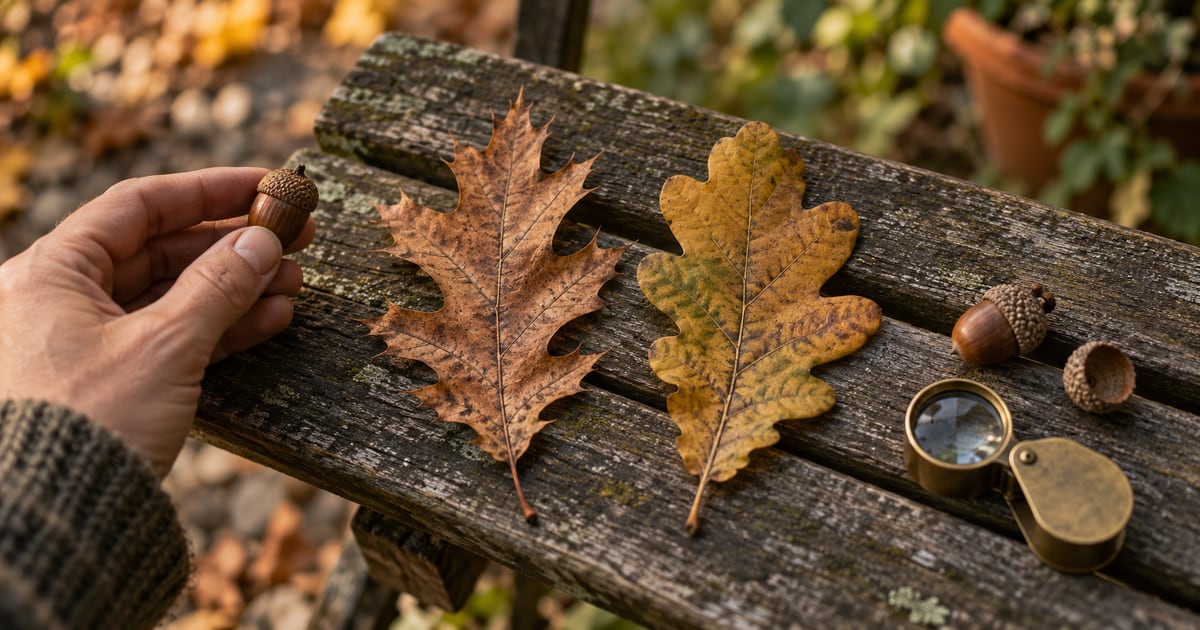


You're standing under a big oak with a fallen leaf in one hand and a question in your head: is this a red oak or a white oak? Maybe you're planning a woodworking project, buying flooring, or just curious on a walk. The fastest answer is at the tip of that leaf. Pointed lobes with a tiny bristle on the end mean red oak. Rounded, smooth lobes mean white oak. Everything else in this guide, from acorns to bark to the end grain of a board, backs up that first clue.
Quick answer: how to tell them apart
"Red oak" and "white oak" are each a group of species, not just one tree. The red oak group includes northern red oak, pin oak, black oak and scarlet oak. The white oak group includes white oak, bur oak, swamp white oak and chestnut oak. The checks below work for the group as a whole, so they help even when you don't know the exact species.
In short:
- Leaf lobes: pointed and bristle-tipped (red) vs rounded with no bristle (white).
- Acorns: take two growing seasons to ripen (red) vs one season (white).
- Bark: darker with flat-topped ridges (northern red oak) vs pale, ashy grey and scaly or blocky (white oak).
- Wood: open pores (red) vs pores plugged with tyloses (white).
- Colour of the wood: pinkish to reddish brown (red) vs light to mid brown (white).
Red oak vs white oak at a glance
| Feature | Red oak group | White oak group |
|---|---|---|
| Leaf lobe tips | Pointed, with a small bristle | Rounded, no bristle |
| Example leaf (typical species) | Northern red oak: 7 to 11 bristle-tipped lobes | White oak: 7 to 10 rounded lobes |
| Acorn ripening | Two growing seasons | One growing season |
| Bark (typical species) | Northern red oak: flat-topped ridges, shallow furrows | White oak: whitish or ashy grey, scaly to blocky plates |
| Pores in the wood | Open | Plugged with tyloses |
| Liquid-tight barrels | No | Yes (most species) |
| Side hardness (Wood Handbook) | Northern red oak: 5,700 N (about 1,290 lbf) | White oak: 6,000 N (about 1,360 lbf) |
| Common members | Northern red, pin, black, scarlet oak | White, bur, swamp white, chestnut oak |
The leaf and acorn rows come from the Virginia Tech dendrology fact sheets for white oak and northern red oak. Hardness figures are from the USDA Forest Products Laboratory's Wood Handbook.
Key difference 1: the leaf tips
This is the most reliable check, and it takes five seconds.
Pick up a leaf and run your finger along the edge of each lobe. On a red oak, every lobe ends in a point, and that point carries a short bristle, sometimes called an awn. On some leaves the bristle is obvious. On others it's tiny, so look closely or use a hand lens. On a white oak, the lobes are rounded like fingertips and there is no bristle at all.
Virginia Tech's fact sheet describes northern red oak leaves as 5 to 8 inches long with 7 to 11 bristle-tipped lobes. White oak leaves are 4 to 7 inches long with 7 to 10 rounded lobes, and they are often whitish on the underside.
A few things can trip you up:
- Lobe depth varies. Both groups can have deep or shallow notches between lobes (the sinuses), even on one tree. Judge by the tip, not the depth.
- Some oaks barely have lobes. Willow oak (a red oak) has narrow, unlobed leaves with a single bristle at the tip. Chestnut oak (a white oak) has wavy, scalloped edges with rounded teeth. The bristle rule still holds.
- Hybrids happen. Oaks within the same group cross fairly often, so you may find leaves that look in between. Hybrids between the red and white groups are not known to be common, so the group usually stays clear even when the species doesn't.
Collect three or four leaves from different parts of the tree before you decide. One odd leaf can mislead you.
Key difference 2: the acorns
Acorns give you a second clue, and they work for months after the leaves fall.
The big difference is timing. White oak acorns ripen in a single growing season, maturing in early fall. Red oak acorns take two growing seasons. On a red oak in summer, you can often find two sizes of acorn on the same branch: tiny first-year ones near the newer growth and full-size second-year ones further back. On a white oak you'll only find one year's crop.
The cap is a useful check too. Virginia Tech describes the white oak acorn cap as warty and bowl-shaped, covering about a quarter of the nut. Northern red oak acorns are 3/4 to 1 inch long and nearly round. The shape of the cap and nut varies a lot from species to species, so treat it as supporting evidence rather than proof.
Key difference 3: the bark
Bark is the trickiest clue, because it changes with age and varies between species in each group. It's still worth a look, especially in winter.
White oak bark is whitish or ashy grey. On younger stems it's scaly. On large, older trunks it breaks into irregular plates or blocks that can look loose at the edges. Old trees often have smooth patches.
Northern red oak bark is smooth on young trees. As it ages it develops long, flat-topped ridges separated by shallow furrows. On many trees those ridge tops look like smooth, slightly shiny stripes running up the trunk.
Other red oaks, like black oak, have darker, rougher, blockier bark. That's why bark works best as a tiebreaker. If the leaves and acorns already point one way, bark can confirm it. On its own it can fool even experienced foresters.
Key difference 4: the end grain of the wood
Once a tree becomes lumber, the leaves are gone. This is where white oak's most famous trait comes in.
Hardwoods move water through tubes called vessels, which show up as pores on the end of a board. In white oak, those vessels fill with tyloses: bubble-like growths from neighbouring cells that block the tube. Red oak vessels mostly stay open.
A 2024 X-ray imaging study in Scientific Reports found about seven times more tylose volume in white oak pores than in northern red oak. That matches what coopers have known for centuries: white oak holds liquid, red oak lets it seep out. It's why barrels for whiskey and wine are made from white oak.
You can check a board yourself:
- Look at the end grain with a hand lens or your phone's zoom. Freshly cut or sanded end grain works best. Red oak pores look like clear, open holes. White oak pores look filled or glassy.
- Try the straw test on a short offcut. Seal your mouth around the end grain of a thin piece of red oak and blow gently, and air can come out the other end through the open vessels. White oak usually blocks it. Only do this on clean, unfinished scrap wood.
One honest exception: not every white oak is fully plugged. Chestnut oak is known for forming tyloses inconsistently, so a chestnut oak board can behave more like red oak.
Key difference 5: colour and figure
Colour is a quick hint in a shop or on a floor, but stains and finishes can hide it.
Unfinished red oak heartwood tends toward pinkish or reddish brown. White oak heartwood is light to mid brown. The hint holds often enough to be useful, but never trust it on stained wood.
Look at quartersawn boards too. Both oaks show ray fleck, the shimmering ribbons that cross the grain. White oak's rays are usually longer, so the fleck appears as longer, bolder streaks. Red oak's rays are shorter, giving smaller flecks.
Hardness differs only a little. The Wood Handbook lists side hardness of 5,700 newtons for northern red oak and 6,000 newtons for white oak. In practice, both are hard enough for floors and furniture; the difference matters more for water resistance than for dents.
Still not sure?
If you've checked the leaf tips, acorns and bark and still can't decide, try these steps:
- Gather more evidence. Collect leaves from sunny and shaded branches, and look under the tree for old acorn caps. Several samples beat one.
- Photograph everything. Take clear photos of a whole leaf, a lobe tip close up, an acorn with its cap, and the bark at chest height. These make it far easier for someone else to help.
- Ask local experts. Your state's cooperative extension office, a local arborist or a native plant society can confirm the species. For lumber, an experienced sawmill or hardwood dealer can usually tell from the end grain in seconds.
- Compare with community records. If you like using apps for this, our comparison of PlantNet vs iNaturalist covers how community-checked records work.
Even experts sometimes settle for "a red oak" rather than a precise species. For flooring, firewood or a nature journal, knowing the group is usually enough.
How Plants & Tree can help
Plants & Tree lets you take a photo of a leaf, bark, a log or a plank, or upload one from your gallery, and get a suggested tree species or wood type. Each result includes common and scientific names, reference images and wood details such as grain pattern, colour, hardness and durability, so you can compare your sample against the checks above. You can save results to a personal collection and review past scans later. Treat any match as a starting point, not a final answer: confirm the leaf tips or end grain yourself, and ask an expert when it matters. It's available on iPhone. For more options, see our list of the best tree identification apps for iPhone.
Frequently asked questions
Is red oak or white oak better for flooring?
Both make durable floors. White oak is slightly harder and its plugged pores resist water better, so it is often chosen for kitchens and entryways. Red oak is a little softer, has a pinkish tone and more open grain, and is usually cheaper. The right pick depends on colour, budget and how much moisture the floor will see.
How can I tell red oak from white oak in winter?
Look on the ground for fallen leaves and acorn caps, which often stay under the tree for months. Then check the bark: white oak is usually pale, ashy grey and scaly or blocky, while northern red oak is darker with long, flat-topped ridges. Bark alone can mislead, so use it alongside leaves or acorns.
Why is white oak used for whiskey and wine barrels?
White oak's water-carrying vessels are filled with tyloses, bubble-like growths that block liquid from moving through the wood. A 2024 study in Scientific Reports measured about seven times more tylose volume in white oak pores than in northern red oak. Red oak's open pores would let liquid seep out.
Are pin oak and black oak red oaks or white oaks?
Both belong to the red oak group. Pin oak, black oak, scarlet oak and northern red oak all have bristle-tipped leaf lobes and acorns that take two seasons to ripen. Bur oak, chestnut oak, swamp white oak and white oak itself belong to the white oak group.
Can a tree identification app tell red oak from white oak?
An app can suggest a species from a clear photo of a leaf or bark, which is a useful starting point. Results are not certain, especially with hybrids, young trees or blurry photos. Confirm the suggestion with the leaf-tip and acorn checks in this guide, or ask a local extension office or arborist.
Conclusion
Telling red oak from white oak comes down to a short checklist. Start with the leaf tips: bristles mean red, rounded lobes mean white. Back that up with the acorns, which take two seasons on a red oak and one on a white oak. Use bark as a tiebreaker, and in cut wood look for open or plugged pores. Gather more than one sample, and ask a local expert when the answer matters. For more tree guides, browse the Plants & Tree blog.