

In one nationwide study, people mailed a spider expert 1,773 arachnids they suspected were brown recluses, from 49 states. From 25 of the 29 states completely or almost completely outside the brown recluse's range, not a single recluse came in (Vetter, 2005). The fear is everywhere. The spider isn't.
That doesn't mean yours is harmless. It means you should check before you panic, and the checks are simple: where you live, how many eyes it has, and whether its legs and abdomen are plain. Here's how to tell if a spider is a brown recluse, step by step.
Why fakes or mix-ups happen
Plenty of spiders are brown, about the same size, and hide in garages and closets. That alone causes most of the confusion.
The famous violin mark makes it worse. People look for a dark shape on the spider's back, and many harmless species have stripes or hair patterns that look like one. UC Riverside's spider experts note that non-experts often misread those markings, while young brown recluses and some western recluse species barely show a violin at all (UCR Spider Research).
There's also a reputation problem. The brown recluse gets blamed for wounds far outside its range. In California, entomologist Rick Vetter has written that verified recluse specimens are rare, yet "recluse bites" are often reported there. Knowing the real signs helps you avoid a scare, and helps you take a real recluse seriously when you find one.
The most common look-alikes:
| Spider | Why it gets confused | How to rule it out |
|---|---|---|
| Spitting spider (Scytodes) | Six eyes in pairs, brownish | Spotted or banded legs and abdomen; no violin |
| Cellar spider | Can show a violin-like mark | Eight eyes; more than one color on the abdomen |
| Male southern house spider | Long legs, brown, similar shape | Eight eyes clumped together; long palps |
| Woodlouse spider | Reddish-brown, hides indoors | Deep red front body and legs with a paler abdomen; large fangs |
| Titiotus (California) | Hair pattern looks like a violin | Eight eyes; outside the recluse range |
Sources: UCR Spider Research, University of Florida EDIS.
7 tests
Work through these in order. A real brown recluse passes every one. If your spider fails even one, it's not a recluse.
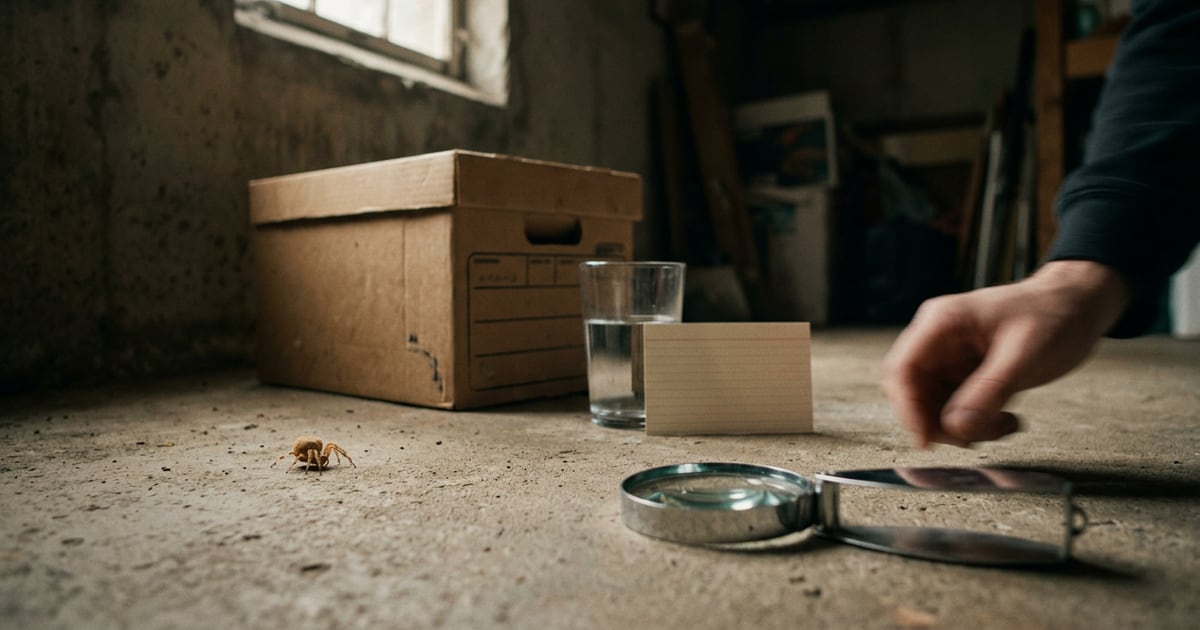
Never pick the spider up with your hands. Photograph it from a short distance, or, if you need a specimen, trap it under a clear glass, slide a stiff card underneath and keep it closed.
1. Check where you live
Start with geography, because it rules out the most spiders. The CDC places the brown recluse in the midwestern and southern United States (CDC NIOSH). University of Florida entomologists describe it as native to the central and south-central US, and note that Florida records are isolated rather than widespread.
Worked example: you're in Oregon and find a brown spider in the garage. Based on Vetter's study, a recluse is very unlikely. It's not impossible, since spiders can travel in boxes and furniture, but you should look for a much more common explanation first.
2. Measure the body
An adult brown recluse's body (not counting legs) is about 3/8 inch, or roughly 7 to 12 mm. UCR's guidance is blunt: if the body is longer than half an inch, it isn't a recluse. Lay a ruler or coin near the spider for scale in your photo. A US dime is about 18 mm across, so a recluse body is well under the width of a dime.
3. Count the eyes
This is the most reliable check. A brown recluse has six eyes arranged in three pairs: one pair at the front and one on each side, with a gap between them. Most spiders have eight eyes. UCR says you can rule out most spiders on this point alone.
You'll usually need magnification. A phone camera zoomed in, or a hand lens, is often enough. If you clearly see eight eyes, or eyes bunched together in a cluster, you can stop here.
Worked example: you trap a small brown spider under a glass in a Missouri closet, well inside the range. The body is about the size of a pencil eraser, so it passes test 2. Zooming in on a photo, you count two rows of eyes, four in each. That's eight eyes, so it isn't a recluse, whatever the mark on its back looks like. Spitting spiders are the tricky case: they also have six eyes in pairs, which is why tests 4 and 5 matter.
4. Look at the legs
Recluse legs are long, thin and evenly light-colored, with no stripes, bands or spots. They're covered in fine hairs but have no thick spines sticking out. If the legs are banded, darker than the body, or bristly with spines, it's another spider.
5. Check the abdomen
The abdomen (the rear body part) is one solid color, from cream to dark brown depending on what the spider has eaten. UCR states that a recluse never has two colors of pigment on its abdomen at the same time. Any stripes, chevrons, spots or patterns rule it out.
6. Find the violin, but don't rely on it
Most adult brown recluses have a dark, violin-shaped mark on the front body section, with the neck of the violin pointing back toward the abdomen. Treat it as supporting evidence only. A clear violin on a spider that failed tests 1 to 5 doesn't make it a recluse. A missing violin on a small, six-eyed spider with plain legs doesn't clear it either, especially if it's young.
7. Notice where it was hiding
Brown recluses are, as the name suggests, reclusive. They build small, irregular retreat webs behind and under things: boxes, stored clothes, baseboards, attic clutter. The CDC lists closets, shoes and attics as indoor hiding spots. A spider sitting in the middle of a large web out in the open, or between plants in the garden, is almost certainly something else.
When home tests aren't enough
Before you ask anyone else, take the kind of photo an expert can actually use. Most identification requests fail because the picture is too blurry or too far away. A few habits help:
- Shoot from directly above for the violin, legs and abdomen, then take a close-up of the front of the body for the eyes.
- Use plenty of light. Daylight from a window or a flashlight held at an angle shows eyes and leg hairs far better than the phone flash.
- Add scale. A ruler or coin next to the glass makes size easy to judge.
- Take several shots. One of them will usually be sharp.
Even with good photos, some spiders are hard to judge at home. Eyes are tiny, photos blur and young spiders look different from adults. In these cases, get a second opinion:
- Ask an expert. Your state's university extension office or a natural history museum can often identify a spider from a good photo or a sealed specimen.
- Call a pest professional if you're finding several spiders in a home inside the recluse range. Vetter documented one Kansas house where 2,055 brown recluses were collected over six months (Vetter and Barger, 2002). Infestations can be large, though no one in that home was bitten.
- Get medical care for any bite that worries you. Don't diagnose a wound from its look. The CDC advises washing the bite, applying a cool compress and seeking professional medical attention. Many conditions are mistaken for recluse bites, so let a doctor decide.
For more side-by-side identification guides, our Species ID blog covers other animals people commonly mix up. The same "signs to check" approach works outside the animal world too, as in our guide on how to tell if a rock is a geode.
How Species ID can help
When you find a spider, a quick, careful photo is the safest first step, and that's where Species ID comes in. Snap or upload the picture and the app suggests likely species, with a profile covering habitat, diet, behavior and natural range. The range information is useful here, since geography is the first test above. Treat the result as a lead, not a verdict: no app can be certain from a photo, so confirm the eyes, legs and abdomen yourself and ask an expert when it matters. Every identification is saved to your personal log. It's available on iPhone, and you can find it on the app page.
Frequently asked questions
What spider is most often mistaken for a brown recluse?
It depends on where you live. University extension experts list spitting spiders, cellar spiders, male southern house spiders, woodlouse spiders and, in California, Titiotus spiders among the usual mix-ups. Most share the brown color or a mark that looks like a violin, but they differ in eye count, leg spines, banded legs or abdomen pattern.
Do brown recluses live in my state?
Brown recluses live mainly in the midwestern and south-central United States, according to the CDC and University of Florida entomologists. In a national study of 1,773 suspected recluses, people in 25 of 29 states fully or mostly outside that range sent in no recluses at all. Check a range map from a university extension service for your area.
Is the violin mark enough to identify a brown recluse?
No. The violin is usually clear on adult brown recluses, but young recluses and some western recluse species barely show it, and many harmless spiders have markings that look like a violin. UC Riverside's spider experts say the six-eye pattern is the more reliable check, along with plain, spineless legs.
What should I do if I think a brown recluse bit me?
Wash the area with soap and water, apply a cool cloth or ice, and get medical care, as the CDC advises. Don't try to diagnose the bite yourself from its appearance. Many skin conditions are mistaken for recluse bites, and a doctor can sort out what is actually going on. If you can do so safely, keep the spider for an expert to check.
Can a phone app tell me if a spider is a brown recluse?
An identification app can suggest likely species and point you to features worth checking, but it can't be certain, especially from a blurry or distant photo. Use it as a starting point, confirm the eyes, legs and abdomen against this guide, and ask a university extension office or a pest professional if it matters.
Conclusion
To tell if a spider is a brown recluse, go in order: check that you're in its range, that the body is under half an inch, that it has six eyes in three pairs, plain spineless legs and a one-color abdomen. Use the violin only as a final hint. Most spiders fail one of those tests, which is why most suspected recluses turn out to be something else. If yours passes them all, keep your distance, ask an expert, and see a doctor about any bite that concerns you.