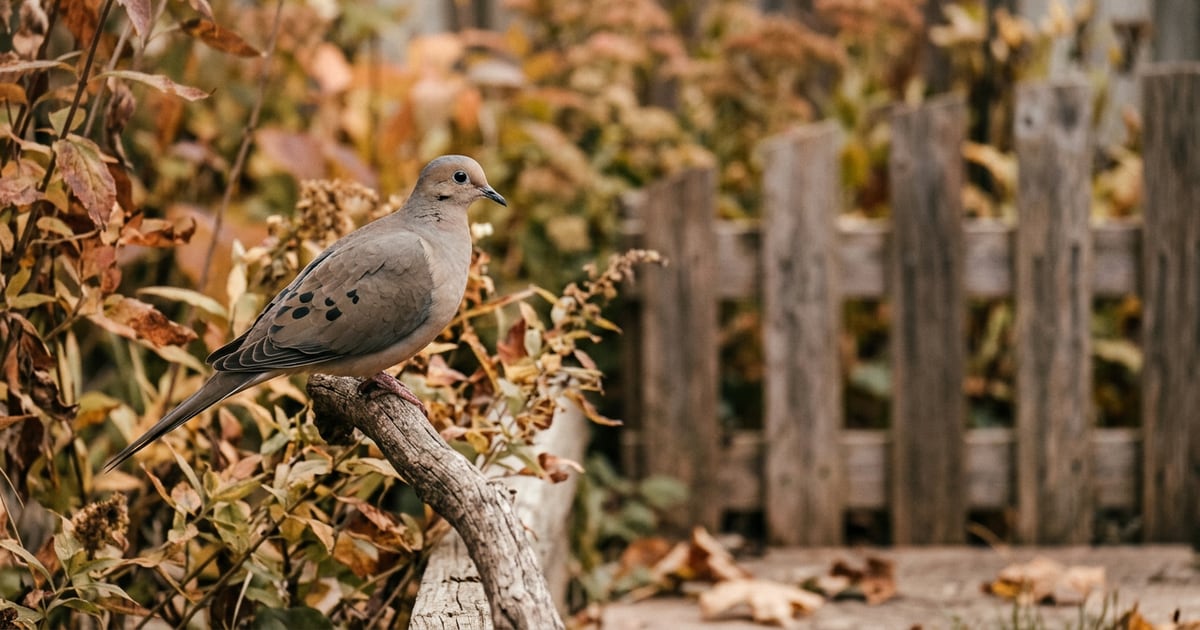


A mourning dove usually shows a small rounded head, a slender bill, black spots on gray-brown wings and a long tapered tail. Look at that combination before relying on colour alone. A young bird can look more scaly than an adult, and a hidden tail can remove one of the best clues. The checks below show how to observe the bird, compare likely look-alikes and record enough information to revisit an uncertain identification later.
What a mourning dove looks like
Start with the outline. A perched bird often looks slim through the head and neck, with a tail that extends well beyond the body. The folded wings carry separate dark spots. Lighting can make its body look warmer or cooler, so compare shape and pattern before choosing a colour name.
Cornell's identification page illustrates adult and juvenile birds from several angles. It describes the small head, thin black bill, spotted wings and pointed tail, and notes pale feather tips on juveniles. Use its photos to compare the part of the bird you actually saw. Cornell Lab identification guide
Record the location and date with your first impression. This guide focuses on a North American species. If you are elsewhere, consult the local dove possibilities before applying a familiar name from an international search result.
A single image may show only the face or chest. In that case, keep the identification tentative and look for a wider view. You can preserve a useful observation without immediately attaching an exact species name.
6 features to check
1. Follow the tail to its tip
Watch for the complete outline of the tail while the bird is perched. Ask whether it narrows toward a point or ends with a broader, more squared shape. A branch can hide the last section, so check that you are seeing the actual tip.
If the bird changes position naturally, take another photograph from where you are standing. Keep both images. The first may show the wing pattern better, while the second reveals the tail.
A practical note could say “long tail, tip partly hidden” instead of “pointed tail.” That wording records the observation faithfully and leaves the unresolved detail visible. It also stops you from using an assumed feature as evidence in the next comparison.
The Missouri conservation guide contrasts the mourning dove's pointed tail with the different tail shapes of white-winged and Eurasian collared-doves. Compare its illustrations with the full silhouette. Missouri dove identification guide
2. Look for distinct dark wing spots
When the bird is side-on, inspect the folded wing. Look for separate black marks and consider where they sit. Keep those observations separate from shadows cast by feathers, twigs or nearby leaves.
An overexposed photo may wash out the body colour while retaining dark spots. A dark photograph may merge several markings into one area. If either happens, compare the original image with another frame before making a decision.
Write a simple description such as “several dark spots on the folded wing.” Avoid treating a heavily sharpened enlargement as a new observation. Image processing can make boundaries look more definite than they were in the original photograph.
Use a wider frame to confirm that the close-up belongs to the same bird you are describing. In a group, it is easy to combine the wing pattern of one individual with the tail view of another. Keep each bird's evidence together until you are satisfied that the features match.
3. Compare head shape and bill
Look at the profile of the head and the proportions of the bill. A clear side view is more useful for this than a photograph of a bird facing directly toward the camera.
Note whether the head looks small and rounded relative to the body and whether the bill looks slender. If the bill is obscured, record that. Do not infer its full shape from a dark line crossing the face.
This check is useful when the tail is temporarily hidden. It gives you another part of the overall combination, though it may still leave several doves as possible matches.
Try describing the bird before opening an identification result. “Small head, slim bill, spotted wing” preserves your own observation. Afterward, compare each phrase with the guide. This order makes it easier to notice a mismatch instead of adjusting your description to fit the first suggestion.
4. Allow for a juvenile's feather pattern
Young mourning doves can show a more scaly appearance. Audubon notes that this can lead to confusion with Inca Doves and Common Ground Doves. Its description also provides adult appearance and seasonal context. Audubon mourning dove guide
If your bird looks scaly, compare it with juvenile reference images before ruling out mourning dove. Check the tail, bill and body proportions at the same time. A pattern on the upperparts alone may not settle the identification.
Save the original file so you can revisit small feather details. A compressed screenshot shared through several services can be harder to compare than the original photograph. Keep a separate note of which features were visible to your eye and which you noticed only in the image.
For example, you might record a scaly back and a long tail in one frame, then add that the bill was obscured. That is enough to ask a focused question of another birder. You do not need to manufacture a complete set of features from an incomplete view.
5. Use voice as additional evidence
If the bird calls naturally, listen while you keep it in view. Record a short clip if you can do so from your existing position, and note whether the sound came from the visible bird or somewhere nearby.
Compare the recording with a reference sound at a comfortable volume later. Avoid relying on how you spell the call in a note, because different observers can describe the same rhythm with different syllables.
A useful record includes the number of repeated notes, any pause and whether you actually saw the bird calling. If you lost sight of it, keep the sound and visual observation linked only as a possibility.
Cornell provides a separate sound page alongside its visual guide. That lets you compare the recording independently after looking at the shape and plumage. Cornell mourning dove sounds
6. Check the setting and your evidence as a whole
Audubon places mourning doves in a broad range of open and semi-open North American settings. Habitat can help you decide which species to compare, but several doves may share the same neighbourhood.
Write down what the bird was doing and where it was. “Perched on a wire above an open yard” is more descriptive than “at home.” Include the town or region and the date so another observer has context.
Then review your evidence as a small checklist. Which features support mourning dove, which are hidden and which seem inconsistent? A contradictory feature deserves attention even when several others look familiar.
| Observation | What to keep in your notes |
|---|---|
| Tail visible | Overall length and tip shape |
| Folded wing visible | Spots, pale areas and image quality |
| Head profile visible | Bill proportions and head shape |
| Scaly-looking feathers | Possible age-related pattern |
| Sound recorded | Whether the visible bird was calling |
| Location known | Region, date and habitat description |
If the bird leaves before you finish, stop with the evidence you have. A tentative record can be improved later through comparison. An unsupported detail is harder to correct once it has become part of the story.
Look-alikes
White-winged Dove. Compare the pale wing feature and tail shape. Cornell's similar-species page highlights differences from mourning dove, including the shorter tail. Use photographs that show those parts instead of comparing faces alone. Cornell similar-species comparison
Eurasian Collared-Dove. Check the back of the neck and the tail. The Missouri guide illustrates a neck band and a squared tail for this species. If those areas are hidden in your image, keep the possibility open rather than declaring the bird a match.
Inca Dove and Common Ground Dove. A scaly-looking young mourning dove can make these worth checking. Compare age-appropriate photographs and local occurrence. The apparent scaling is a reason to investigate the alternatives, while the rest of the bird supplies the comparison.
A list of names is only the start. Put the most informative image next to a reference and compare the same feature in both. If your image lacks the distinguishing part, another photograph or experienced observer may be needed.
For practice comparing multiple features, the crow and grackle guide shows the same observational approach on a different pair of birds. The details differ, but recording the whole combination remains useful.
When to ask an expert
Ask a local bird group or experienced observer when the location is unusual, the photograph is incomplete or the visible features point in different directions. Share the original photographs, date, region and a short list of what you saw.
Phrase the question around the uncertainty. For example, “Could this be a juvenile mourning dove? The back looks scaly, but the tail tip is hidden.” That gives the reviewer a specific comparison to make.
An app suggestion can help generate names to investigate. Compare those names with local reference material and the features in your photo. The Seek and iNaturalist comparison describes other ways people explore identification and observations.
How Species ID can help
Species ID is an iPhone app whose supplied description includes camera or uploaded-photo identification, species profiles and a saved wildlife log. It can give you a starting suggestion to compare with your own observations.
Use a clear image that shows the bird's shape and visible markings. Keep location and date notes with the original photo so you can revisit the suggestion later. A saved result is a record of the proposed identification, and its certainty still depends on the evidence available. If the image hides the features that distinguish similar doves, ask an experienced observer to help review it.
Frequently asked questions
What are the main mourning dove identification features?
Look at the small head, slender bill, spotted folded wings and long pointed tail together. A single feature may fit several birds, so compare the overall shape and pattern with a reference image showing the same angle.
Why does a young mourning dove look scaly?
Juvenile mourning doves can show pale tips on upperpart feathers, producing a scaly appearance. Compare age-appropriate reference photographs and check the tail and bill as well. Scaling alone can lead to confusion with other small doves.
How can I compare a mourning dove with a white-winged dove?
Look for a clear view of the wing and full tail. White-winged doves have a distinctive pale wing feature and a different tail outline. If your photograph hides those areas, keep both possibilities open until you have more evidence.
What should I share when asking someone to identify a dove?
Share original photographs along with the date, region and a short description of what the bird was doing. Explain which features you could see and which were hidden. A specific question about the uncertain feature helps another observer review it.
Conclusion
Look for a mourning dove's overall combination of slim head and bill, spotted wings and long tapered tail. Allow for the scaly appearance of a young bird, and use sound and location to strengthen the comparison. Keep hidden or uncertain features visible in your notes. When the evidence remains mixed, preserve the original photos and ask a local observer to compare the specific details you could see.