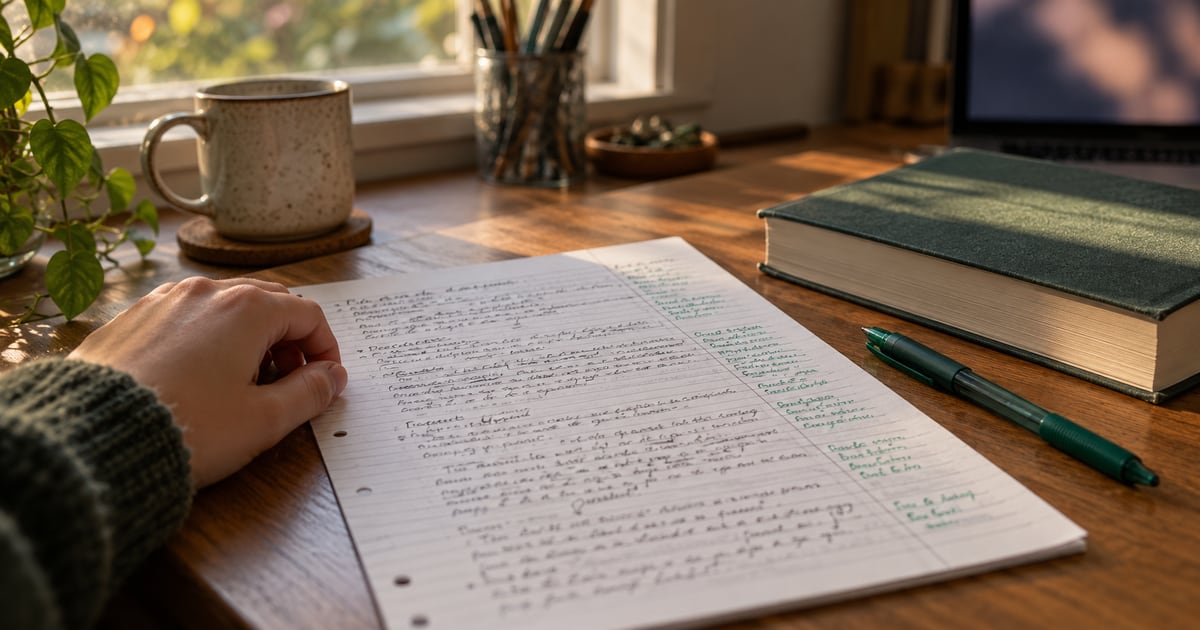


The most common mistake with the blurting method is the check. Students write everything they remember on a blank page, which is the right start, then open their notes and simply read them again from the top. That turns a recall exercise back into rereading, the exact habit blurting is meant to replace. The fix is small but changes everything: compare your page with the source line by line, write only what you missed in a different colour, and blurt those gaps again a day later. The extra colour is your real study list.
What is the blurting method?
Blurting is a revision technique built on one question: what can I produce from memory, right now, with no help?
The basic cycle has three parts:
- Learn a small topic from your notes, textbook or lecture.
- Blurt. Close everything and write down all you can remember on a blank page, in any order, as fast as you can.
- Check and fill. Open the source, compare, and add what you missed or got wrong in a second colour.
Then you come back later and blurt the same topic again, paying extra attention to whatever was in the second colour last time.
The name comes from the writing phase: you "blurt" information onto the page without stopping to organise it. Blurting is popular with GCSE and A-level students in the UK, but it works for any subject where you need to recall facts, processes or explanations: biology, history, law, nursing, chemistry theory.
It is a type of active recall (also called retrieval practice). Flashcards test you on one fact at a time, with a prompt. Blurting gives you no prompt at all except the topic name, so it shows how much of a whole topic you can rebuild alone.
Why it works
Blurting borrows its power from a well-studied effect in memory research: retrieving information strengthens it more than reading it again.
In a 2006 study published in Psychological Science, Roediger and Karpicke had students learn short prose passages. Some reread a passage several times; others read it once and then practised writing down what they remembered. On a test five minutes later, the rereading group did better. After one week, the result flipped: students who had practised recall remembered considerably more. Rereading felt more effective in the moment, but recall practice lasted.
A 2011 study in Science by Karpicke and Blunt found that students who practised free recall of a science text did better on a later test than students who built detailed concept maps of the same text, even on questions that asked them to draw inferences.
In a large 2013 review of ten common study techniques, Dunlosky and colleagues rated practice testing and distributed practice (spacing study out over time) as the two most useful. Rereading, highlighting and summarising were rated low. A well-run blurting routine uses both high-rated techniques: you test yourself, and you repeat the test after gaps.
There is also a practical reason. A blank page is honest. When you reread, everything looks familiar, so you feel ready. When you blurt, the missing pieces are visible in front of you.
How to do it step by step
Here is the full method, with a worked example on a common biology topic: photosynthesis.
1. Pick one narrow subtopic
Blurting a whole chapter gives you a messy page and vague gaps. Choose something you could explain in about five minutes.
Example: not "plant biology" or even "photosynthesis", but "the two stages of photosynthesis and where they happen".
2. Study it properly once
Read your notes or textbook section carefully, aiming to understand rather than memorise word for word. Try to explain each idea to yourself as you go. A free source like OpenStax Biology 2e works if your notes are thin.
3. Close everything and blurt
Put away the book, close the tabs and turn your phone face down. Write the topic at the top of a blank page and set a timer for 5 to 10 minutes. Write everything you remember: facts, keywords, arrows, diagrams, half-remembered terms. Don't worry about neat order.
Example blurt:
Photosynthesis happens in chloroplasts. Carbon dioxide + water → glucose + oxygen. Needs light. Two stages: light reactions and the Calvin cycle. Light reactions make ATP and something else. Calvin cycle uses CO2 to make sugar. Chlorophyll absorbs light.
4. Check line by line in a second colour
Now open the source. Go through it section by section and compare. Use a different pen to:
- Add what you left out.
- Correct anything wrong.
- Circle anything vague, such as "something else".
Example corrections (in green):
Light-dependent reactions happen in the thylakoid membranes. They split water, which releases oxygen, and make ATP and NADPH. The Calvin cycle happens in the stroma and uses ATP and NADPH to fix CO2 into sugar. Balanced equation: 6CO2 + 6H2O → C6H12O6 + 6O2.
Now the gaps are obvious: locations of each stage, the source of the oxygen, NADPH and the balanced equation.
5. Turn the green into questions
Rewrite each correction as a question you can be tested on. "Where do the light-dependent reactions happen?" "Where does the oxygen in photosynthesis come from?" These questions become flashcards or the focus of your next blurt.
6. Blurt again after a gap
Come back the next day and blurt the same subtopic onto a fresh page, without looking at yesterday's version. Check again. If the green ink shrinks, you are learning. Then space the next attempt further out, such as three days, then a week.
7. Join topics together near the exam
Once each subtopic comes out cleanly, blurt larger chunks: "photosynthesis and respiration", then the whole unit. Linking topics from memory is close to what long exam answers ask you to do.
Common mistakes
Rereading instead of checking. As covered at the top, the check should be targeted. Read the source to find differences, not to study it all again.
Peeking during the blurt. Glancing at your notes "just for one word" ruins the test. If you're stuck, write "?" and move on. The question mark is useful data.
Blurting topics that are too big. A whole chapter in ten minutes produces a shallow list of headings. Narrow it until you can go into detail.
Only blurting once. One blurt shows you the gaps; it doesn't close them. Repeating after a gap is what builds lasting memory.
Blurting straight after reading, every time. Writing everything down two minutes after reading feels great but mostly tests short-term memory. Leave at least a short break, or do another topic first.
Using it where it doesn't fit. Blurting tests recall. For maths and other problem-solving subjects, use it for formulas and methods, then practise unseen problems. Our guide on how to memorize polyatomic ions shows how to combine recall with other techniques for a list-heavy chemistry topic.
Judging yourself by how full the page looks. A long blurt full of loose keywords can hide weak understanding. When you check, ask whether each line would earn marks as written. "Light reactions make ATP and something else" shows you know the shape of the idea, but an examiner wants the exact term. Mark vague lines as gaps, even if they're roughly right.
Throwing the page away. Keep your corrected blurts. The second-colour notes are a ready-made list of your weak spots for final revision.
How Meomy AI can help
Blurting needs two things: something to check against and a way to find your weak spots. Meomy AI is an iPhone study app that turns uploaded PDFs, audio files or voice recordings into notes, summaries, quizzes and flashcards. That gives you a clean reference for the checking step, and ready-made quizzes and flashcards for the gaps you find.
If you prefer to blurt out loud, its Feynman AI sessions let you practise explaining a concept and get feedback and a clarity report showing where your understanding is weak. Progress tracking shows whether those weak areas improve over time. You can read more study guides on the Meomy AI blog or compare options in our best flashcard app for iPhone roundup.
Frequently asked questions
Is blurting the same as active recall?
Blurting is one form of active recall. Active recall means pulling information out of memory instead of reading it again. Flashcards, practice questions and teaching a topic out loud are other forms. Blurting differs by using free recall on a blank page, so you see how much of a whole topic you can rebuild without any prompts.
How long should a blurting session take?
Keep the writing phase short, around 5 to 10 minutes for one subtopic, and stop when you run dry. Checking and correcting takes about as long again. Short sessions on narrow topics work better than one long blurt of a whole chapter, because the gaps are easier to see and fix.
Does the blurting method work for maths?
Only partly. Blurting suits content you need to recall, such as definitions, formulas, processes and the steps of a method. Maths skill comes from solving problems, so use blurting to recall the formula and the method, then practise with unseen questions to check you can apply it.
Should I blurt on paper or say it out loud?
Either works, as long as you produce the answer from memory before checking. Writing leaves a record you can mark up in a second colour. Saying it out loud is faster and suits a walk or a commute, but record yourself or you'll have nothing to check against your notes.
How often should I repeat a blurt?
Repeat it after a gap rather than straight away. A common plan is to blurt again the next day, then a few days later, then a week after that, focusing on the parts you missed. Spacing your practice out over time is one of the two study techniques rated most useful in a major 2013 review.
Conclusion
The blurting method is simple: study a small topic, write everything you remember on a blank page, check it against the source in a second colour, and repeat after a gap. It works because recalling information builds stronger memories than rereading, and spacing those attempts out makes them last. Most of its value sits in the check, so keep it targeted and keep the corrections. Start today with one narrow subtopic, ten minutes and two pens.