
Black Walnut Tree Identification: 6 Features to Check
Identify a black walnut tree from its 15 to 23 toothed leaflets, diamond-ridged bark, round green nuts and chambered pith, plus the look-alikes to rule out.
 Alic Systems · 8 min read

In this article
How do you identify a black walnut tree? Look for long feather-like leaves with 15 to 23 toothed leaflets, dark bark with diamond-shaped ridges, and round green nuts the size of a tennis ball that stay sealed in their husks. If two or three of those line up, you are probably looking at Juglans nigra. This guide walks through six features to check in any season, the look-alikes that trip people up, and when to ask an expert before you act on your answer.
What a black walnut tree looks like
Black walnut is a large native tree of central and eastern North America. NC State Extension lists a mature height of 50 to 90 feet, a trunk 3 to 6 feet across and a crown spreading 50 to 70 feet. In a forest it grows a long, straight, clear trunk with a narrow crown, as Virginia Tech's dendrology fact sheet describes. In an open yard or field it spreads wider and rounder.
From a distance, a few things stand out:
- Airy foliage. The long compound leaves give the crown a light, feathery look.
- Short leaf season. The leaves come out late in spring and drop early in fall, turning bright yellow first.
- Nuts on the ground. From late summer into October, round green or blackened husks collect under the tree.
- A thin garden below. Black walnut releases juglone, which holds back the growth of some plants under its dripline.
None of these alone proves anything. Use them to decide the tree is worth a closer look, then work through the six features below.
6 features to check on a black walnut tree
1. Long compound leaves with many leaflets
Each leaf is pinnately compound: a central stalk with leaflets lined up along both sides, like a feather. NC State gives a leaf length of 12 to 24 inches with 15 to 23 leaflets. Virginia Tech gives a slightly wider range of 10 to 24 leaflets, so treat the count as a range, not a rule.
The tip of the leaf is a useful clue. The single leaflet at the very end is often small or missing, so many black walnut leaves end in a pair. Purdue Extension notes that most black walnut leaves have two leaflets at the tip.
Check it: Pick one leaf that has fallen or hangs low, count the leaflets on one stalk, and look at the end. A count in the high teens or low twenties with a paired tip points toward black walnut.
2. Finely toothed, lance-shaped leaflets with a strong smell
Each leaflet is lance-shaped, roughly 3 to 3.5 inches long, and finely serrated along the whole edge. Virginia Tech describes them as yellow-green to green above and a little paler below. Compared with pecan, NC State says black walnut leaflets are more oval, more numerous and less sharply toothed.
Smell is a second check. Purdue Extension describes crushed tree-of-heaven leaves as smelling like rancid peanut butter, which walnut leaves do not.
Check it: Run a fingertip along a fallen leaflet's edge. Teeth all the way around fit black walnut. A nearly smooth edge with one or two bumps near the base points to tree-of-heaven instead.
3. Dark bark with diamond-shaped ridges
On mature trees the bark is thick, dark brown to almost black, and deeply furrowed. The ridges cross and merge so the trunk looks covered in a rough net of diamonds. NC State calls them "diamond-shaped plates." Virginia Tech adds that the bark looks darker still where it has been cut.
Young trees are different. Their bark is smoother and lighter, and the diamond pattern only appears as the trunk thickens. This is why sapling ID is harder: lean on leaves and twigs for small trees.
Check it: Step back about ten feet and look at the trunk as a whole. A dark trunk with a crisscross diamond pattern fits black walnut. Light ashy-gray bark with flattened ridges fits English walnut better.
4. Round nuts in a green husk that stays closed
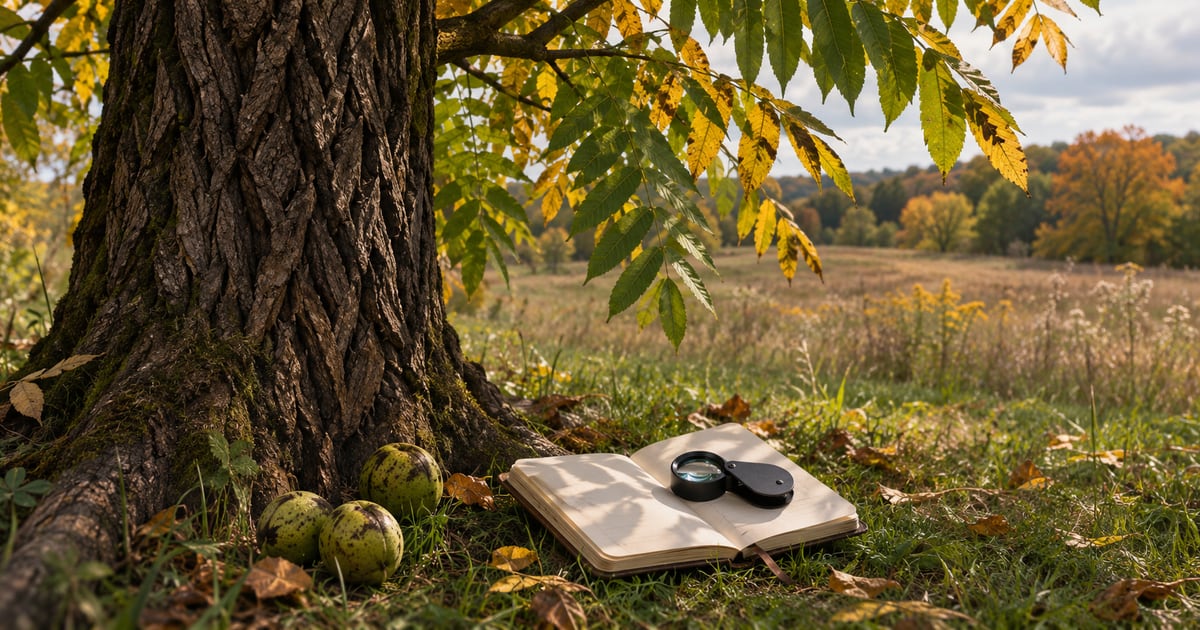
The fruit is the easiest clue in late summer and fall. Black walnut nuts are round, 1 to 3 inches across, and borne singly or in pairs, according to NC State. Each sits inside a thick yellow-green husk that does not split open on its own. On the ground the husk softens and turns brown, then black.
Inside is a hard, furrowed nut. NC State notes the husk heavily stains skin and clothing dark brown, so wear gloves if you pick one up to look at it.
Check it: Look under the tree for round husks, green or black. A cluster of three to seven oval fruits suggests butternut. A husk that splits neatly into four sections suggests a hickory.
5. Chambered pith and a monkey-face leaf scar
This is the best winter check. Cut a fallen twig lengthwise with a pocket knife and look at the soft center, the pith. In walnuts it is divided into a ladder of tiny chambers with hollow spaces between them. Black walnut's pith is light brown or buff, per Go Botany and Virginia Tech.
Then look at where last year's leaves were attached. Black walnut's leaf scar is three-lobed, and Virginia Tech says it resembles a monkey face. The twigs are stout, light brown, and carry large tan buds.
Check it: Chambered, light brown pith plus a monkey-face scar is a strong walnut signal. Dark brown chambered pith suggests butternut. Solid pith means you are not looking at a walnut at all.
6. Chocolate-brown heartwood with pale sapwood
If you have a log, stump, firewood round or plank, the wood itself can help. A Hardwood Floors species profile, drawing on the USDA Forest Products Laboratory's Wood Handbook, describes the heartwood as light greyish brown to dark chocolate brown or even purplish black. The outer sapwood is nearly white to yellowish gray. The contrast is strong unless the wood was steamed during manufacturing, which evens out the color.
Check it: On a fresh cut, look for a sharp line between a dark brown core and a thin pale outer ring. Wood can be stained to imitate walnut, so check the end grain or an unfinished edge rather than a finished face.
Look-alikes
Five trees cause most mix-ups. This table pulls the key differences from the sources above.
| Tree | Leaflets | Bark | Fruit | Pith |
|---|---|---|---|---|
| Black walnut | 15–23, toothed all around, tip often paired | Dark, diamond ridges | Round, single or paired, husk stays closed | Chambered, light brown |
| Butternut | Similar long compound leaf | Use fruit and pith instead | Oval, in clusters of 3–7 | Chambered, dark brown |
| English walnut | Usually 5–7 (sometimes 9), mostly smooth-edged, large tip leaflet | Light ashy gray | Round, thinner husk, smoother nut | Chambered, buff |
| Tree-of-heaven | 11–41, nearly smooth with glandular teeth at the base, single tip leaflet | Use leaflets instead | Clusters of winged seeds | Use leaflets instead |
| Hickories | Fewer; shagbark mostly 5 | Varies; shaggy in shagbark | Husk splits into 4 parts | Solid |
A few notes on the hardest pairs:
- Butternut is the closest relative. If you think you have one, pith color and fruit shape are the fastest checks.
- English walnut is planted in yards and orchards. Its leaves have far fewer leaflets, and Virginia Tech's English walnut sheet describes its bark as light, ashy gray.
- Tree-of-heaven is invasive. Purdue Extension calls the glandular teeth near each leaflet base the best feature for separating it from native trees.
- Hickories have solid pith, as Go Botany's shagbark hickory page shows. For bark and wood differences in that family, see our guide to hickory vs ash.
Staghorn sumac also gets mistaken for young walnut. Penn State Extension lists it with black walnut and hickory as the common compound-leaf look-alikes; sumac twigs are hairy and its fruits are red, fuzzy clusters.
When to ask an expert
A field ID is a best guess, whether it comes from a book, a checklist or an app. Get a second opinion from your county extension office, a certified arborist or a local native plant society in these cases:
- Before you cut, sell or buy timber. Walnut logs can be valuable, and a mistaken ID costs money. A forester can confirm the species and judge the log.
- If you keep horses. Purdue Extension warns that stall bedding should never contain black walnut wood, because walnut shavings are linked to laminitis in horses. Ask your vet and bedding supplier, rather than relying on your own guess about a pile of shavings.
- If a pet or animal may have eaten husks or fallen nuts. NC State lists black walnut as a problem for dogs and horses. Call your veterinarian rather than trying to treat anything yourself.
- When planning a garden near the tree. Juglone sensitivity varies by plant, and your extension office can tell you which crops suit your spot.
- For young trees and saplings. The bark pattern is not there yet, and tree-of-heaven seedlings look very similar.
If you are tracking several trees on a property, the Nature ID blog has more field guides, including how to identify a sycamore tree.
How Plants & Tree can help
Plants & Tree lets you take a photo of a tree or a piece of wood, or upload one from your gallery, and suggests a likely species. It works with leaves, bark, logs, planks and furniture, which suits black walnut, since you may meet it as a yard tree, a firewood round or an old tabletop. Each result shows common and scientific names, reference images, wood grain and color, hardness and durability, plus safety notes on toxic or harmful species. You can save each find to a personal collection and review past scans later.
Treat the result as a starting point. Compare it with the six features above, and ask an expert before you cut, sell or plant around the tree.

Frequently asked questions
How can you tell a black walnut tree from a butternut?
Look at the fruit and the pith. Black walnut fruits are round and hang singly or in pairs, and the chambered pith in the twigs is light brown. Butternut fruits are oval, come in clusters of three to seven, and its pith is dark brown, according to the Native Plant Trust's Go Botany guide.
How do you identify a black walnut tree in winter?
Without leaves, rely on bark, twigs and fallen nuts. The bark is dark with ridges in a rough diamond pattern. Twigs are stout, with a three-lobed leaf scar that looks like a monkey face, and a cut twig shows a pith divided into small chambers. Old blackened husks often lie under the tree.
How many leaflets does a black walnut leaf have?
NC State Extension lists 15 to 23 leaflets on a leaf 12 to 24 inches long, and Virginia Tech gives a slightly wider range of 10 to 24. The tip leaflet is often small or missing, so many leaves end in a pair of leaflets rather than one.
Is black walnut the same as tree-of-heaven?
No. Tree-of-heaven is an invasive tree with similar long compound leaves, but its leaflets are almost smooth-edged except for one to a few glandular teeth near the base, and it produces clusters of winged seeds instead of nuts. Black walnut leaflets are toothed along the whole edge.
Why do plants die under a black walnut tree?
Black walnut leaves, stems and roots contain juglone, a compound that holds back the growth of some plants under the tree's dripline. NC State Extension lists azaleas, peonies, tomatoes, apples and blueberries among sensitive plants. Struggling tomatoes near a big tree can be a clue, not proof.
Conclusion
Black walnut tree identification comes down to a short checklist. Count the leaflets and look for a paired tip. Feel for teeth along the whole edge. Step back and look for diamond-ridged dark bark. Check the ground for round, unsplit husks. In winter, cut a twig and look for chambered, light brown pith under a monkey-face scar. On wood, look for a chocolate core with a pale rim. When three or more of these agree and the look-alikes are ruled out, you have a confident field ID. For anything with money, animals or a garden riding on it, confirm with a local expert.
Keep reading
Sweetgum Tree Identification: 6 Features to Check
Learn sweetgum tree identification with 6 checks for pointed leaves, alternate twigs and spiny fruit, plus tips for separating common look-alikes.

How to Tell If Wood Is Veneer: 6 Nondestructive Checks
Learn how to tell if wood is veneer using 6 visual checks, component notes and existing edges, plus when to stop and ask a furniture specialist for help.
Red Oak vs White Oak: 5 Ways to Tell the Trees and Wood Apart
How to tell red oak from white oak by leaf lobes, acorns, bark and end grain, plus why white oak pores hold about 7 times more tylose plugs.