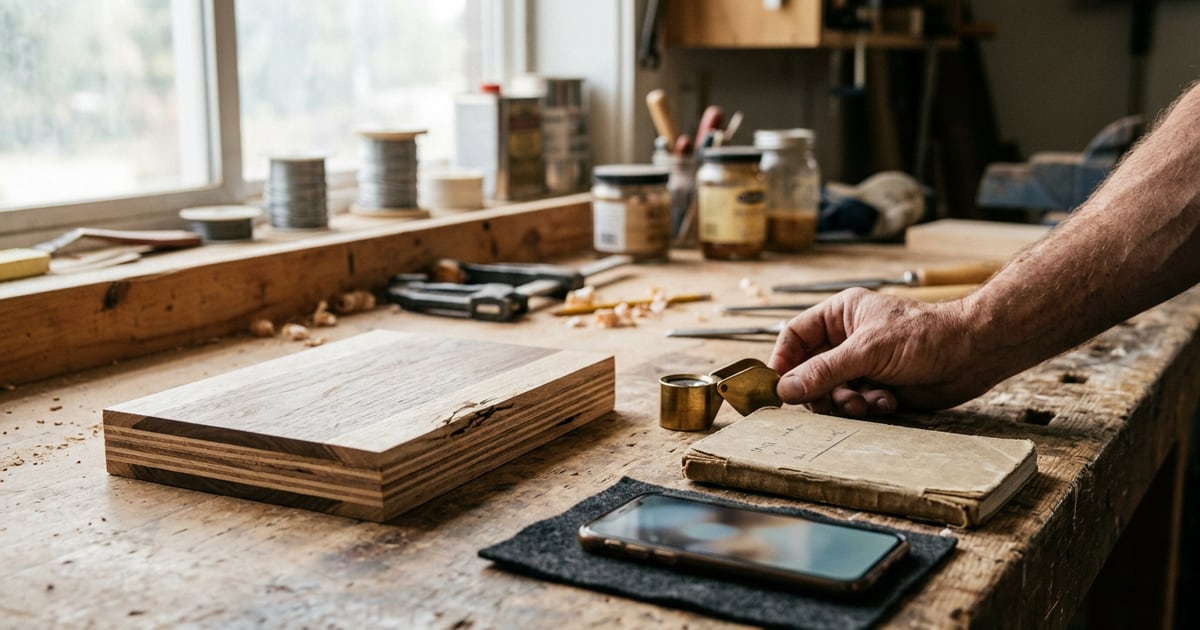


Veneer is real wood: Natural Resources Canada's forestry glossary defines it as a thin layer peeled or sliced from a log and used over other wood products. So the useful question is not simply whether your furniture is “real wood.” It is whether a particular component is solid through its thickness, covered by a wood veneer, or finished with an imitation surface. Start with visible construction evidence and stop short of damaging the finish to obtain an answer.
Why fakes or mix-ups happen
Furniture descriptions often combine appearance, species and construction in one short phrase. “Oak finish” describes an appearance without necessarily explaining the material beneath it. Even a genuine oak surface does not establish that the whole top, door or cabinet is solid oak.
A single item may also use several constructions. The legs might be solid wood, the top veneered and the back a different panel. Inspecting one drawer cannot settle the construction of every other component.
Veneer should not automatically be called fake. It is a construction material. A printed wood-effect surface is a different category, and neither category alone tells you the quality of the complete piece.
The US Forest Service Wood Handbook treats solid wood and wood-based products as distinct materials with different structures and applications. Identification begins by asking which structure you can actually observe.
The checks below are observations, not destructive experiments. Use good light, a phone camera and any existing exposed edges. Do not scrape a finish, cut a corner or peel a loose surface to make the construction easier to see.
For broader context on comparing wood characteristics, the tree and wood learning articles provide related reading. Keep the construction question separate from the question of species.
6 tests to assess veneer without damaging furniture
1. Read the description component by component
If the maker's label, original invoice or product page is available, look for precise wording about the component you are examining. Record “solid oak legs” separately from “oak veneer top.”
Ask a seller a specific question: “What is the core material of the tabletop, and is its upper surface veneered?” This is more useful than asking whether the entire item is real wood.
If the answer only repeats a colour name or finish description, you still lack construction information. Treat that as uncertainty rather than filling in a preferred answer.
For example, suppose a listing says “walnut cabinet with solid timber feet.” That establishes a claim about the feet but leaves the cabinet panels unresolved. Photograph the label and compare it with the actual component before deciding.
Documentation can be incomplete or refer to a different version of a product. Keep physical observations beside it. If the paperwork and visible construction disagree, ask for clarification rather than assuming one ambiguous phrase settles the matter.
2. Inspect an already exposed cross-section
An existing unfinished edge or damaged area may show a thin face layer over a different core. That is stronger evidence than surface colour alone.
Do not create that exposed section yourself. Look only where construction is already visible, such as an accessible panel edge. If the entire component is wrapped or covered, note that the core is hidden.
Natural Resources Canada's plywood description explains that plywood is built from bonded veneer layers with adjacent grain directions crossing. Visible layers can therefore identify a plywood component, though they do not establish the species of its decorative face.
A core may also look different from the surface without being neatly layered. Describe exactly what you see before naming it. “Thin brown surface over a uniform pale core” is a useful observation; “definitely solid walnut” is not supported by that observation.
Take a close photograph and a wider photograph showing where the detail sits. Without the wider view, a specialist may not know whether the picture shows a drawer bottom, a tabletop or an unrelated repair.
3. Compare the face with the edge cautiously
Follow the visible grain toward an edge. Look for a boundary between a broad face and a narrow edging strip. Such a boundary may indicate separate materials or pieces, but it is not conclusive by itself.
Solid wood components can be joined, and veneered panels can have solid edging. A seam tells you that construction deserves closer examination; it does not automatically identify every layer.
End grain can provide useful information when genuinely exposed. However, a covered edge may hide it completely. Do not assume that an uninterrupted decorative pattern proves solid construction.
Imagine a top with an attractive grain face and a narrow, separately fitted perimeter. The correct next step is to inspect an existing visible underside or seek a maker's specification, not to remove the perimeter.
Avoid universal rules such as “any seam means veneer.” Furniture is assembled from components, and the significance of a seam depends on where it is and how the surrounding piece is made.
4. Examine the underside and other accessible surfaces
Look underneath only if you can do so safely without tipping a heavy item or stressing joints. A mirror or phone camera may allow inspection without moving the furniture.
Compare the top, underside and visible edge of the same component. A different underside can suggest a layered construction, but it cannot alone establish what lies between the surfaces.
Do not use a solid drawer side as proof that the cabinet top is solid. Keep separate notes for each part: top, door, side panel, shelf, drawer front and base.
The Canadian Conservation Institute's care guidance emphasizes checking for loose joints before moving furniture and lifting at strong parts. Identification is not worth causing a joint failure.
If access requires dismantling fixed parts, stop. An uncertainty recorded honestly is better than damage caused by an unnecessary inspection. Ask the owner or a qualified furniture specialist to arrange any further examination.
5. Distinguish surface evidence from species guesses
Colour and grain appearance are clues, but finishes, lighting and the visible cut can complicate identification. A photo that resembles oak does not prove an oak core or solid-oak construction.
The Wood Database's identification guide specifically distinguishes identifying a real wood veneer from identifying a solid piece. The visible species and the underlying construction are separate questions.
Use a two-line note: “Surface species: uncertain” and “Construction: thin face layer visible over a different core.” This lets you retain a useful construction finding without pretending the species is known.
Repeated patterns deserve comparison, but repetition alone is not a verdict. Compare several details and keep the original photographs. Do not enlarge a small image until compression artifacts start looking like wood anatomy.
If you are comparing oak groups, the red oak and white oak guide addresses that narrower identification question. It does not turn a photograph of a finished tabletop into proof of the material throughout its thickness.
6. Weigh the evidence instead of trusting a single shortcut
Organize your observations into stronger evidence, supporting clues and unanswered questions. This prevents a weak impression from becoming an unjustified conclusion.
| Observation | What it supports | What it does not establish |
|---|---|---|
| A visible thin wood face over a distinct core | A layered component | Exact species throughout the item |
| Crossed wood layers at an exposed edge | Plywood construction at that location | Construction of every other component |
| A maker's precise component specification | A documented material claim | That an unrelated part uses the same material |
| A seam near an edge | Separate pieces or a construction boundary | Veneer by itself |
| A wood-like surface photograph | A starting point for comparison | Hidden core composition |
Do not rely on weight, price or a tap sound as a stand-alone answer. Those impressions do not reveal a hidden cross-section. You can record them, but they should not override clear construction evidence.
A sensible conclusion may be limited: “The top appears veneered; the core is not visible.” That is more useful for the next conversation than a confident claim about the whole cabinet.
When home tests aren't enough
Stop when the surface completely conceals the construction, the item has historical or financial significance, or your next step would involve cutting, sanding or dismantling.
A furniture conservator can assess an older or valuable piece without treating identification as permission to refinish it. The Canadian Conservation Institute cautions that original finishes can carry historical value and that removing them is irreversible.
If you are considering a purchase, ask for a written material description and clear photographs of relevant existing edges. If you are planning restoration, ask the specialist what construction information is needed before any treatment is proposed.
For instance, discovering a thin surface changes the question from “How much can I sand?” to “What is an appropriate conservation or repair approach for this component?” This article does not prescribe a sanding depth or treatment.
Bring your photos, labels and component notes to the specialist. Include what remains unknown. A close-up of the surface, another of a visible edge and a wider view of the whole component usually communicate the question better than a single heavily cropped picture.
No home observation or app result should be used to certify a seller's claim, assign an appraisal value or justify irreversible work. Those decisions need evidence appropriate to their consequences.
How Plants & Tree can help
Plants & Tree is an iPhone identification app whose supplied feature description includes photo-based tree and wood identification, wood information and a saved collection. It may help you compare a visible wood surface with possible species descriptions.
Use any result as a lead for further checking. The supplied description does not establish that the app detects veneer, identifies a concealed core or certifies furniture construction. Save clear photographs and compare the suggestion with independent references. When construction remains uncertain or a repair decision matters, ask a qualified specialist rather than treating a species suggestion as proof of solid wood.
Frequently asked questions
Is veneer real wood?
Yes. Wood veneer is a thin layer peeled or sliced from a log and applied over another material. The visible surface can therefore be genuine wood without the entire component being solid through its thickness. Construction and species are separate questions.
Can a piece contain both solid wood and veneer?
Yes. Different components can use different constructions, so a solid leg or drawer side does not prove that the top or cabinet panel is solid. Inspect and document each component separately, and ask for precise material descriptions where available.
Does a seam prove that furniture is veneered?
No. A seam can show a construction boundary, but solid pieces can also be joined and a veneered panel can have solid edging. Combine the seam observation with an existing exposed cross-section or precise documentation rather than treating it as proof.
Should I sand a corner to check for veneer?
No. Do not create damage to identify the construction. Inspect only already exposed details and seek qualified advice if the layers remain hidden. This is especially important for older or valuable pieces, where original finishes may be significant.
Conclusion
To tell whether a component is veneered, begin with precise documentation and any already exposed construction details. Compare the same component's face, edge and underside, and keep species identification separate from core identification. Veneer is real wood, so “real versus fake” is often the wrong starting question. Record uncertainty, avoid creating damage for a closer look and seek specialist advice before making a purchase or restoration decision that depends on the answer.