
Hackberry Tree Identification: 6 Features to Check
Identify a hackberry tree by its warty bark, lopsided leaf base, pea-sized purple fruit and nipple galls, plus how to rule out sugarberry and elms.
 Alic Systems · 8 min read

In this article
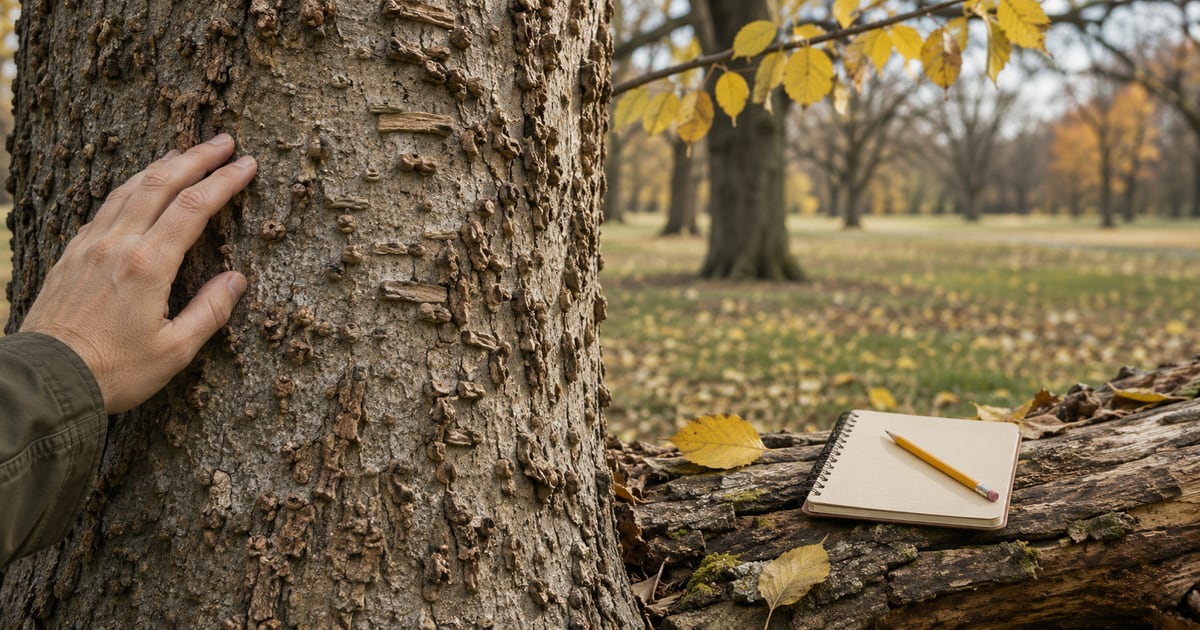
How do you identify a hackberry tree? Look at the trunk first: a hackberry's grey bark is covered in corky warts and knobby ridges, and almost no other common eastern tree looks like that. Then confirm with the leaves, which are rough, toothed and noticeably lopsided at the base. (If you've walked past one for years assuming it was "some kind of elm", you're in good company.) Below are the six features that settle it, the trees it gets mixed up with, and how to check it in winter, when the leaves are gone and most guides stop being useful.
What a hackberry tree looks like
Common hackberry (Celtis occidentalis) is a small to medium tree, usually 40 to 60 feet tall with a wide, spreading crown, according to University of Maryland Extension. It's a tough tree: NC State Extension notes it often grows in bottomlands, and Virginia Tech says it's an increasingly popular street tree because it survives very dry conditions.
It was long filed with the elms, and its leaves do look elm-ish from a distance. Botanists now place it in the hemp family, Cannabaceae, alongside hops.
From the sidewalk, a hackberry often looks a bit untidy. The crown can be lumpy with clusters of short twigs, the leaves often carry bumps, and the trunk looks as if it was assembled from cork. Those "flaws" are your best clues.
Hackberry grows across much of the eastern United States. On the southern Gulf slope, its close relative sugarberry (Celtis laevigata) largely replaces it, according to Ohio Woody Plants. Keep that in mind if you're in Louisiana or the Florida Panhandle.
6 features to check
Check at least three of these together. One feature on its own can mislead you; three that agree are hard to argue with.
1. Warty, corky bark
This is the headline feature. Virginia Tech's dendrology fact sheet describes the bark as smooth and grey-brown when young, soon developing corky individual "warts" that later grow into rough, irregular corky ridges.
What to do: run your hand down the trunk at chest height. Hackberry warts feel spongy and knobby, not hard and flaky like oak or ash.
Worked example: you find a 1-foot-wide grey trunk in a park with raised bumps that look like wax drips, some merging into short wavy ridges. That combination points strongly to hackberry. A smooth grey trunk alone could be beech or a young maple, so move on to the leaves before you decide.
Watch the branches, too. NC State Extension notes that bark on the limbs can be smooth enough to resemble beech. The warts show best on the main trunk.
2. A lopsided leaf base with three veins
Pick a leaf and look at where the blade meets the stalk. On hackberry, one side starts noticeably lower than the other. Virginia Tech calls this an "inequilateral base", and notes that three distinct veins fan out from it.
The leaf is ovate, 2 to 5 inches long, with a long tapering tip. Leaves are alternate and grow in two flat rows along the twig, forming sprays like an elm's.
Why it works: plenty of trees have toothed oval leaves, but few combine an uneven base with three main veins starting from the same point. It's a quick check you can do in five seconds.
3. Single teeth and a sandpaper surface
Now look at the edge. Hackberry leaves are singly toothed, meaning each tooth is simple, with no smaller tooth on its side. NC State describes the margin as coarsely toothed from about the middle of the leaf to the tip, and the surface as rough.
Rub the top of the leaf between your fingers. Many hackberry leaves feel like fine sandpaper. UF/IFAS Extension uses that exact contrast, describing common hackberry as having smaller, sandpapery leaves than sugarberry.
This is also your main elm test (more on that under look-alikes), so it's worth getting used to what "single" teeth look like.
4. Small round fruit that turns dark purple
Hackberry fruit is a round drupe, 1/4 to 3/8 inch across, that turns orange-red to dark purple when ripe and matures in early fall (Virginia Tech). Each one hangs on its own slender stalk, about 1/2 to 3/4 inch long, rather than in bunches, and NC State notes the fruit often persists through winter.
Worked example: in November you spot a tree with scattered pea-sized, wrinkly dark purple fruits on long stalks, each holding a single hard pit. Paired with warty bark, that's a confident hackberry match.
Birds love them. University of Maryland Extension lists quail, wild turkey, robins and cedar waxwings among the fruit eaters, so a tree full of waxwings in late fall is a decent hint by itself.
5. Bumpy nipple galls under the leaves
Turn a leaf over. If the underside is dotted with small knobs, and the top has matching blistered spots, you're probably looking at hackberry nipple galls. They're made by tiny psyllid insects whose young grow inside the leaf tissue.
Iowa State University Extension puts it plainly: the gall is so common on hackberries that its presence can be used to identify the tree. It also says the galls don't cause serious harm to healthy trees.
Bonus clue: the Missouri Department of Conservation notes that the adult psyllids, small brownish insects under 1/4 inch long, gather on window screens in late summer and fall. If your screens fill with tiny cicada-like bugs every October, the tree next to the house is worth a look.
6. Winter clues: zigzag twigs, chambered pith and witches' brooms
Most hackberry guides assume you have leaves. In winter, use the twigs.
- Twigs: slender and zigzag, light red-brown with many pale dots (lenticels). There's no true end bud, and the small, triangular side buds sit pressed flat against the twig (Virginia Tech).
- Pith: cut a twig lengthwise with a pocket knife. Hackberry pith is often chambered at the nodes, meaning you'll see thin cross-walls with small hollow spaces between them, like a tiny ladder.
- Witches' brooms: dense clusters of short, stubby twigs at branch ends. Iowa State Extension links them to a powdery mildew fungus working together with a tiny mite. Once the leaves drop, a crown peppered with these brooms is one of the easiest ways to spot a hackberry from across a field.
Yes, cutting open twigs is slightly obsessive. It's also the quickest way to win an argument about a leafless tree.
Look-alikes
Virginia Tech lists sugarberry, American elm, winged elm and dwarf hackberry as the trees most often confused with common hackberry. Here's how to separate the main ones.
| Tree | Leaves | Fruit | Bark |
|---|---|---|---|
| Common hackberry | 2 to 5 in, broad, rough, single teeth from mid-leaf to tip, lopsided base | Round, 1/4 to 3/8 in, orange-red to dark purple | Grey with corky warts and ridges |
| Sugarberry | Narrower, lance-shaped, smoother, mostly smooth edges with few teeth | Similar small drupe | Also warty, often very warty |
| American elm | Doubly toothed, pinnate veins, lopsided base | Flat, papery wafer 3/8 to 1/2 in across, deeply notched, ripens in spring | Dark ashy grey, flat-topped ridges with diamond-shaped fissures |
Sugarberry. The hardest one. The University of Tennessee says sugarberry's leaves differ in having mostly smooth edges with few teeth. Bark won't help much, since both are warty. Location helps: in the Deep South, sugarberry is the more likely tree. Where both grow, hybrids with in-between leaves turn up, so some trees will stay "a Celtis, probably" (and that's an honest answer).
American and winged elm. Elms share the lopsided leaf base, which is why they cause so much confusion. Check the teeth: elm leaves are doubly toothed, with small teeth on the sides of bigger ones. Virginia Tech describes American elm fruit as a flat, papery, wafer-like samara, 3/8 to 1/2 inch across, that ripens in spring, and its bark as flat-topped ridges split by diamond-shaped fissures. A papery wafer is nothing like hackberry's round purple drupe, and elm bark lacks the corky warts.
Dwarf hackberry. A smaller relative in the same genus. If your hackberry-like plant is unusually short and shrubby, it's worth checking a regional key or asking your extension office.
If you're already sorting out other confusing trees, our guides to sycamore identification and sweetgum identification use the same feature-by-feature approach.
When to ask an expert
Most hackberries are easy once you've seen a few. Bring in help when:
- You're telling hackberry from sugarberry in a zone where both grow and the leaves look in between. A county extension office or a state herbarium can look at a pressed sample.
- The tree is near your house and looks unhealthy. Brooms and galls are mostly cosmetic, but cracked limbs, large dead sections or mushrooms at the base call for a certified arborist.
- You're deciding whether to cut it down or keep it. Identity matters for wildlife: Maryland Extension notes that hackberry emperor butterfly caterpillars depend on hackberry leaves.
- Anything involves eating or using the tree for medicine. Never rely on a field guide or an app for that.
Your county's Cooperative Extension office, usually run with your state's land-grant university, can often point you to a local plant identification service.
How Plants & Tree can help
Not sure about the bark in front of you? Plants & Tree lets you photograph a tree's leaves or bark, or upload a photo from your gallery, and suggests a likely species with its common and scientific names, reference images and notes on habitat and lifespan. That's handy for a first guess on a walk, especially in winter when bark is all you have.
Treat the result as a starting point, not a final answer. Compare it with the six features above, and for a hackberry versus sugarberry call, ask a local expert. You can save each find to your collection and check the same tree again in spring when the leaves are back. More tree guides live on our Nature ID blog, and the app page has the details.

Frequently asked questions
What does hackberry bark look like?
Young hackberry bark is smooth and grey-brown. It soon grows small corky bumps, often called warts, that later join into rough, irregular corky ridges. On a mature trunk it can look like someone glued gravel and cork strips to the tree, which is why bark is usually the first thing people notice.
How can I tell a hackberry from an elm?
Look at the leaf edge and the fruit. Elm leaves are doubly toothed, with small teeth on the big teeth, while hackberry leaves have single teeth. American elm fruit is a thin, flat, papery disc notched at the tip. Hackberry fruit is a small round berry-like drupe that turns orange-red to dark purple.
What are the bumps on the underside of hackberry leaves?
Those are hackberry nipple galls, made by tiny psyllid insects. The leaf tissue grows around the young insects, leaving knobby bumps underneath and blistered spots on top. Iowa State Extension says the galls are so common they can help you identify the tree, and they usually don't seriously harm healthy hackberries.
How do you tell hackberry from sugarberry?
Compare the leaves. Common hackberry leaves are broader, rough like sandpaper and toothed from about the middle to the tip. Sugarberry leaves are narrower, lance-shaped, smoother and have mostly smooth edges with few teeth. The two can hybridise where ranges meet, so some trees sit in between.
Can you identify a hackberry tree in winter?
Yes. Use the warty bark, slender zigzag twigs with small buds pressed flat against them, and pith that is often chambered at the nodes when you slice a twig lengthwise. Dark fruit often hangs on into winter, and dense twig clusters called witches' brooms stand out once the leaves drop.
Conclusion
Hackberry is one of the friendlier trees to identify once you know where to look. Start with the warty, corky bark. Confirm with a rough, singly toothed leaf that has a lopsided base and three veins. Then add any of the bonus clues: small dark purple fruit on long stalks, nipple galls under the leaves, zigzag twigs with chambered pith, or witches' brooms in the crown. Three matching features make a confident call. And if the leaves are narrow and nearly smooth-edged, think sugarberry before you write "hackberry" in your notebook.
Keep reading
Black Walnut Tree Identification: 6 Features to Check
Identify a black walnut tree from its 15 to 23 toothed leaflets, diamond-ridged bark, round green nuts and chambered pith, plus the look-alikes to rule out.
Sweetgum Tree Identification: 6 Features to Check
Learn sweetgum tree identification with 6 checks for pointed leaves, alternate twigs and spiny fruit, plus tips for separating common look-alikes.

How to Tell If Wood Is Veneer: 6 Nondestructive Checks
Learn how to tell if wood is veneer using 6 visual checks, component notes and existing edges, plus when to stop and ask a furniture specialist for help.