
How to Use a Pregnancy Test Strip: 7 Steps for a Clear Result
How to use a pregnancy test strip step by step: when to test, how to dip it, and why you should read it within the time window, usually 3 to 5 minutes.
 Alic Systems · 8 min read

In this article
To use a pregnancy test strip, dip the absorbent end into a cup of fresh urine up to the marked line, lay the strip flat, and read it within the time window on the leaflet, often about 3 to 5 minutes. A line in the control area tells you the test worked. A second line in the test area usually means the test found the pregnancy hormone hCG. Timing matters as much as technique: the NHS says tests are most reliable from the first day of a missed period, and a strip read too early or too late can give a confusing answer.
Before you test
Test strips (sometimes called dip strips) are the simplest home pregnancy tests: a thin paper strip with no plastic case, meant to be dipped in a cup of urine. They work the same way as other urine tests. According to the FDA, they look for human chorionic gonadotropin (hCG), a hormone made by the placenta. The NHS notes that the body starts making hCG about 6 days after fertilisation, so there is a short gap before any test can pick it up.
A few things are worth checking before you open the pouch.
Your timing. If you know when your period is due, wait until at least that day. If you don't, the NHS suggests testing at least 21 days after the last time you had unprotected sex. The FDA adds that about 10 to 20 out of every 100 pregnant people will not get a positive result on the first day of a missed period, often because cycles vary. Waiting a little longer gives a clearer answer.
Your urine. Cleveland Clinic recommends first-morning urine when you can, because hCG is most concentrated then. The NHS says any time of day can work. If you test later in the day, Cleveland Clinic suggests not urinating for about three hours first and not drinking large amounts beforehand, since extra fluid can dilute the hormone.
Your medicines. The NHS says hormonal contraception, such as the combined pill, does not stop a pregnancy test from working. Cleveland Clinic notes that fertility medicines containing hCG can cause a false positive. If you take any fertility treatment, ask your clinic when it's safe to test.
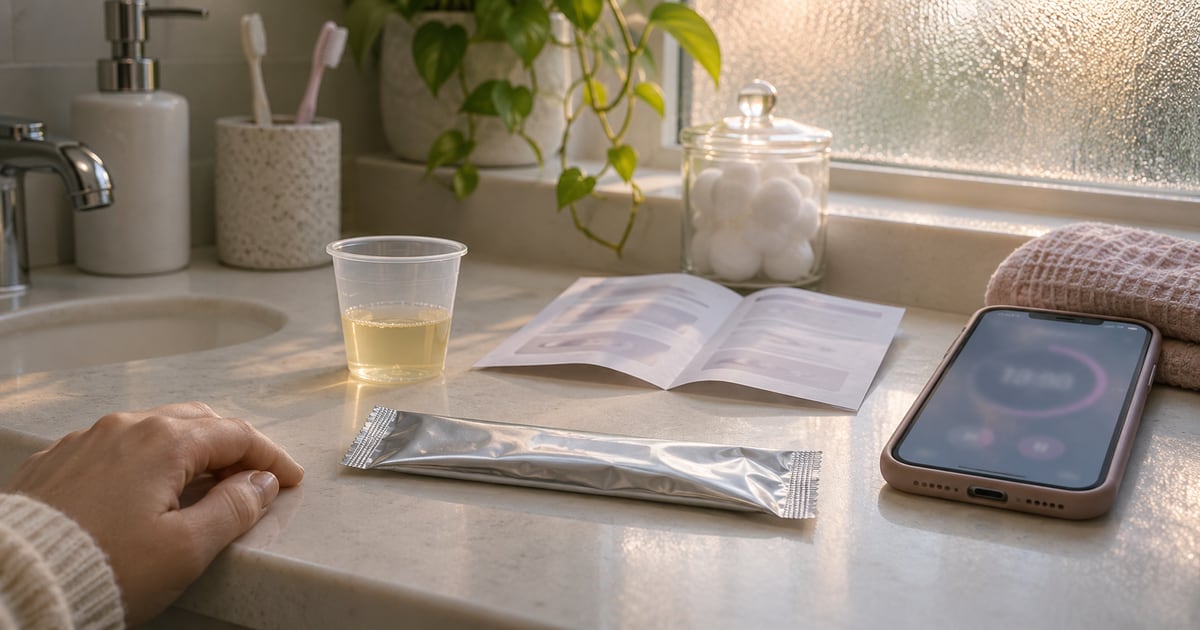
Your kit. You need the strip, a clean dry cup, a timer (a phone is fine), and the leaflet from the box. Brands differ in dipping time, reading time and line placement, so the leaflet always wins over any general guide, including this one.
Step by step
1. Read the leaflet first
Look for three numbers: how long to dip, how long to wait, and the latest time you can read the result. Note where the control (C) and test (T) areas are on your brand. Some strips have a coloured MAX line or arrows showing which end goes into the urine.
2. Check the strip
Look at the expiry date on the foil pouch, and don't use a strip if the pouch is torn. Leave the strip sealed until you are ready, then hold it by the handle end. Avoid touching the absorbent tip or the result window.
3. Collect urine in a clean cup
Pee into a clean, dry container. Collect enough that the tip of the strip can sit in the urine up to the MAX line without the cup tipping over. Soap residue or water left in the cup can affect the sample, so rinse and dry it well beforehand, or use a new disposable cup.
4. Dip to the line, not past it
Hold the strip upright and lower the absorbent end into the urine. Stop at the MAX line. Keep it there for the number of seconds the leaflet gives. Going past the line, or leaving it in too long, can flood the strip. Cleveland Clinic lists using too much or too little urine as one cause of a misleading result.
5. Lay it flat and start the timer
Take the strip out and place it on a clean, dry, flat surface, such as a folded paper towel. Start your timer straight away. Don't shake the strip or hold it upside down while it develops.
6. Wait for the full reading time
Most urine tests take about 3 minutes to show a result, according to Cleveland Clinic, and the FDA says the result typically takes about 5 minutes. Use the time printed on your leaflet. Checking at 60 seconds and seeing only one line doesn't mean much yet.
7. Read it within the window, then throw it away
Read the strip in good, even light once the timer ends. Cleveland Clinic warns that an evaporation line can appear if you wait too long and advises reading the result before the 10-minute mark. After the reading window, the result no longer counts. A strip is single-use, so don't re-dip it.
Reading the result
Every strip has a control line. It shows the test has absorbed urine and the chemistry worked. Here is how to read the common patterns.
| What you see in the window | What it usually means | What to do |
|---|---|---|
| Control line only | Negative: no hCG found at this level | Retest in a few days if your period doesn't come |
| Control line and test line, any strength | Positive: hCG was found | Book an appointment with a doctor or midwife |
| Test line only, no control line | Invalid: the test didn't work | Use a new strip |
| No lines at all | Invalid | Use a new strip |
| A line that appeared after the reading window | Can't be trusted | Retest with a new strip and read it on time |
A faint test line still counts. Cleveland Clinic says even a faint line could mean you are pregnant. In early pregnancy hCG is still low, so a light line is common. What matters is that the line appears within the reading time and has some colour.
A positive is more reliable than a negative. The NHS says a positive result is almost certainly correct, while a negative result is less reliable, especially if you tested early. False positives are rare. Cleveland Clinic lists a chemical pregnancy (a very early loss) and fertility medicines containing hCG among the causes.
A home test is not a diagnosis. A strip tells you whether it found hCG. It cannot tell you how far along a pregnancy is or whether it is developing as expected. Only a doctor, a midwife or a blood test can confirm a pregnancy. The FDA notes that a doctor can consider your history and other tests alongside the result.
If the lines are hard to make out, a photo in good light can help you look again calmly. Some people also use a reading app such as AI Pregnancy Test Reader for a second look. Either way, an unclear strip is a reason to retest, not to guess.
When to test again
After a negative result. If your period still hasn't arrived, the NHS suggests waiting a few days and testing again. hCG rises quickly in early pregnancy, so a test two or three days later may show a line that wasn't there before. The FDA says the most reliable results come 1 to 2 weeks after a missed period. If you get a second negative and your period still doesn't come, see your GP or doctor.
After a faint or unclear result. Retest in two to three days with first-morning urine and read it on time. If the line becomes clearer, that points towards a positive. If you are still unsure after several tests, Cleveland Clinic advises contacting your healthcare provider.
After an invalid result. Repeat it straight away with a new strip, following the leaflet carefully. If strips from the same box keep failing, the batch may be faulty or out of date.
After a positive result. You don't need to keep testing to prove it. Contact a doctor, midwife or your local maternity service to arrange care. Cleveland Clinic suggests calling to book an appointment even if it is several weeks away. In the UK, the NHS lets you refer yourself to a midwife.
Get urgent help if something feels wrong. The NHS says to call emergency services or go to A&E straight away if you have sudden, sharp and intense pain in your tummy, especially with dizziness, fainting, feeling sick or looking very pale. Go to urgent care for heavy bleeding, too. Don't wait for a test result first.
You can find more calm, sourced guides on reading home tests on our pregnancy test blog.
How AI Pregnancy Test Reader can help
When a line is faint or the light in your bathroom is poor, a second look can be reassuring. AI Pregnancy Test Reader lets you take a photo of your test strip or kit and gives you a reading straight away. It works with several kinds of home pregnancy tests and explains what a positive or negative reading generally means, so you're not left staring at the window alone.
It is a reading aid, not a diagnosis. The app can be wrong, especially with blurry photos or strips read outside their time window. Use it alongside the leaflet, and confirm any result with a doctor, midwife or blood test. The app is available for iPhone. You can read more on the app page.

Frequently asked questions
How long do you leave a pregnancy test strip in urine?
It depends on the brand, so follow the leaflet in your box. Most dip strips are held in the urine for a few seconds, up to the maximum line and no further. Dipping too long or too deep can flood the strip and make the result hard to read.
Can I use a pregnancy test strip at any time of day?
Yes. The NHS says you can collect urine at any time of day. First-morning urine usually has the most hCG, so it may help if you are testing early. If you test later, Cleveland Clinic suggests holding your urine for about three hours first.
What does it mean if only one line shows on a test strip?
If only the control line appears, the result is usually read as negative. If no control line appears at all, the test did not work and you need a new strip. A negative result is less reliable than a positive one, especially if you tested before your period was due.
Is a faint line on a test strip positive?
Cleveland Clinic says even a faint line could mean you are pregnant, as long as it appears within the reading time. A line that shows up after the window has passed may be an evaporation line. Retest in two to three days and speak to a doctor or midwife to confirm.
Are pregnancy test strips as accurate as midstream tests?
Both detect the same hormone, hCG, and both are accurate when the instructions are followed. The difference is mostly how you apply urine and how sensitive each brand is. Check the box for the brand's stated sensitivity and when it recommends testing.
Conclusion
Using a pregnancy test strip comes down to three habits: test on the right day, dip only to the marked line, and read the result within the window your leaflet gives. A control line means the test worked, and a second line of any strength usually means hCG was found. A negative result early on is less certain than a positive one, so retest in a few days if your period doesn't arrive. Whatever the strip shows, a doctor, midwife or blood test is what confirms a pregnancy. Seek urgent care for severe pain or heavy bleeding.
Keep reading

Black Walnut Tree Identification: 6 Features to Check
Identify a black walnut tree from its 15 to 23 toothed leaflets, diamond-ridged bark, round green nuts and chambered pith, plus the look-alikes to rule out.

Sweetgum Tree Identification: 6 Features to Check
Learn sweetgum tree identification with 6 checks for pointed leaves, alternate twigs and spiny fruit, plus tips for separating common look-alikes.

PictureThis vs Blossom for Plant ID and Daily Care
Compare PictureThis vs Blossom for plant identification, photo symptom checks and daily care, with five documented differences to guide your choice.